
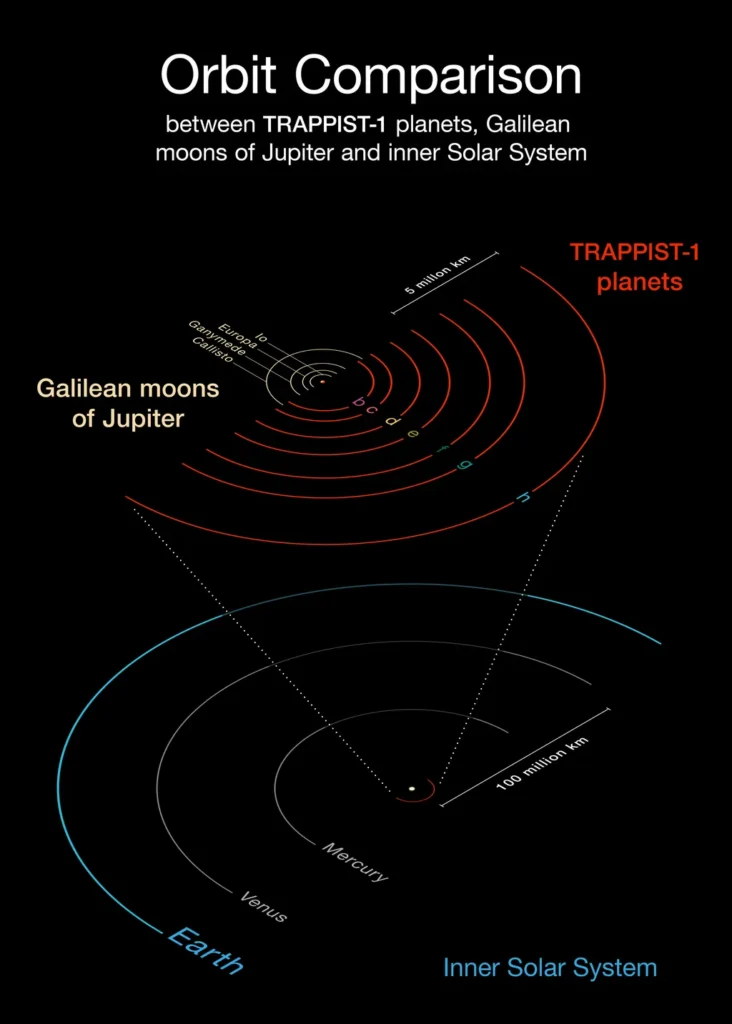
In the realm of energy journalism, it’s not every day that we delve into astrophysics, but a recent study by Shubham Dey and Sean N. Raymond from the University of Bordeaux offers insights that could have intriguing implications for our understanding of planetary systems and, by extension, the energy dynamics within them. Their research, published in the journal Astronomy & Astrophysics, explores the stability of potential moons around the seven planets of the TRAPPIST-1 system, a topic that might seem far removed from Earth’s energy sector but holds lessons about orbital mechanics and long-term stability that could inform our own celestial energy dynamics.
The study investigates the dynamical stability of potential satellites orbiting the seven planets of the TRAPPIST-1 system using a suite of N-body simulations. For each planet, the researchers show that moons can remain stable from the Roche limit out to near the theoretical prograde stability boundary at roughly 0.5 Hill Radii. The Roche limit is the distance within which a moon would be torn apart by tidal forces, while the Hill radius is the region around a planet where its gravitational influence dominates over that of the central star.
The researchers quantify how perturbations from neighboring planets modify these stability limits. Although the overall effect of individual perturbers is generally weak, the combined gravitational influence of the full multi-planet configuration produces a modest contraction of the outer stable radius, notably for TRAPPIST-1 b and TRAPPIST-1 e. For each of the seven planets, the outer stability limit for satellites is at 40-45% of the Hill radius, consistent with previous work.
Using simple long-term tidal decay calculations, the study shows that the most massive satellites that could survive over Gyr (billion-year) timescales are 10^(-7-9) Earth masses (with higher possible masses for the outer planets). This means that any moons around these planets would need to be relatively small to remain stable over long periods.
So, what does this mean for the energy sector? While the study itself is focused on astrophysics, the principles of orbital mechanics and long-term stability are crucial for understanding the dynamics of celestial bodies that could potentially be harnessed for energy. For instance, understanding the stability of moons around exoplanets could inform future efforts to explore and utilize resources in our own solar system. Additionally, the study’s findings could have implications for the stability of space-based energy infrastructure, such as satellites or space stations, which must remain in stable orbits to function effectively.
In summary, while the study by Dey and Raymond is primarily about the stability of moons around the TRAPPIST-1 planets, its findings offer valuable insights into the principles of orbital mechanics and long-term stability that are relevant to the energy sector. As we continue to explore and utilize space for energy purposes, understanding these principles will be crucial for ensuring the stability and longevity of our celestial energy infrastructure.
This article is based on research available at arXiv.