
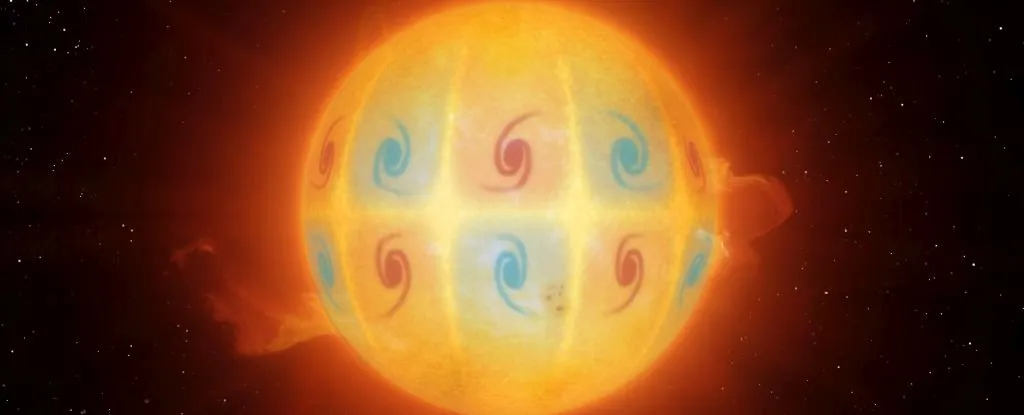
In the realm of solar physics, a team of researchers from the University of Glasgow and the University of Warwick, led by Lauren McClure, has made strides in improving the detection of small-scale vortices in the solar photosphere. These vortices play a crucial role in transporting mass, energy, and momentum into the upper solar atmosphere, making their accurate detection vital for understanding solar dynamics.
The team introduced a simple yet effective preprocessing step that normalizes the velocity field by its magnitude. This method preserves the flow topology while suppressing shear-induced artifacts that often lead to false detections in non-uniform, high-rotation environments. To validate their approach, the researchers applied it to high-resolution Bifrost simulations and evaluated vortex detection using four commonly employed methods: IVD, the λ2-criterion, the Q-criterion, and the Γ method.
The researchers found that, in the unnormalized field, a substantial fraction of detections made by the first three methods were false positives. However, normalization removed most of these false detections. The Γ method, which underpins most observational analyses, was found to detect true vortices but miss a large number of vortical flows. The normalization step yielded better-defined and more realistic vortex boundaries, suggesting that current studies likely capture only a subset of vortical flows.
Overall, this physically motivated preprocessing step enhances the accuracy and physical realism of vortex detection. The researchers suggest that the true photospheric vortex coverage may be underestimated by a factor of four to five, highlighting the importance of this enhancement for analyzing vortical flows in turbulent environments. This research was published in the Astrophysical Journal.
This article is based on research available at arXiv.