
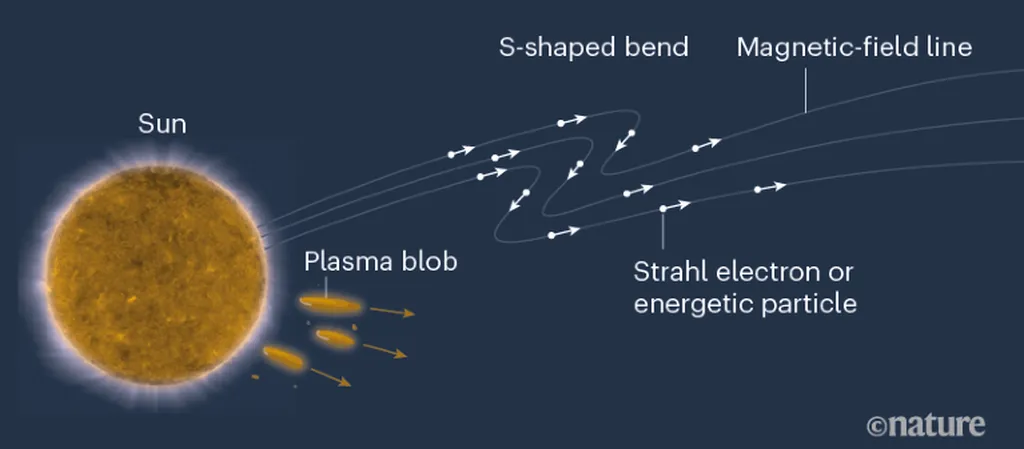
In the realm of plasma physics and space weather research, a team of scientists from various institutions including the University of Alabama in Huntsville, NASA Goddard Space Flight Center, and the University of Iowa have made significant strides in understanding plasma behavior in the solar wind. Their work, published in the journal Physical Review Letters, explores the constraints on plasma parameters driven by the drift of alpha particles, which are helium ions.
The researchers, led by Mihailo M. Martinović, have delved into the complex interactions within low-beta plasmas—plasmas where the thermal pressure is much lower than the magnetic pressure. Specifically, they investigated the role of a drifting proton beam or alpha-particle population in triggering an Oblique Drift Instability (ODI). This instability is crucial as it influences the velocity drift between the thermal proton and secondary populations, thereby affecting the overall stability and heating of the plasma.
The study reveals that a sufficiently fast and dense drifting population can trigger the ODI. This instability acts to decrease the velocity drift between the thermal proton and secondary populations. Importantly, it also prevents the plasma beta (the ratio of thermal to magnetic pressure) from decreasing below a minimum value by heating both the core and drifting populations. This mechanism provides an additional pathway for the perpendicular heating of ions, which is particularly relevant in the vicinity of the Alfvén surface, a critical boundary in the solar wind where the solar wind speed equals the Alfvén speed.
The findings are of particular interest for the Parker Solar Probe, a NASA mission designed to study the Sun’s outer atmosphere and the solar wind. The research provides a new mechanism to explain the observed heating of ions near the Sun, addressing discrepancies between theoretical predictions and actual measurements. Specifically, it explains why beta is consistently measured above a few percent and why secondary populations drift faster than the bulk of the proton population by no more than approximately one Alfvén velocity.
For the energy sector, understanding plasma behavior in the solar wind can have practical applications. Plasma physics is integral to the development of fusion energy, where controlling plasma stability and heating is crucial. The insights gained from this research can inform strategies for managing plasma conditions in fusion reactors, potentially leading to more efficient and stable energy production. Additionally, the study of solar wind interactions can improve space weather forecasting, which is essential for protecting satellites and other space-based infrastructure that are vital for energy and communication systems on Earth.
In summary, the research by Martinović and colleagues sheds light on the complex dynamics of low-beta plasmas in the solar wind. By identifying the role of the Oblique Drift Instability, they provide a new framework for understanding plasma heating and stability. These findings not only advance our knowledge of solar wind physics but also offer valuable insights for the energy sector, particularly in the realm of fusion energy and space weather prediction.
This article is based on research available at arXiv.