
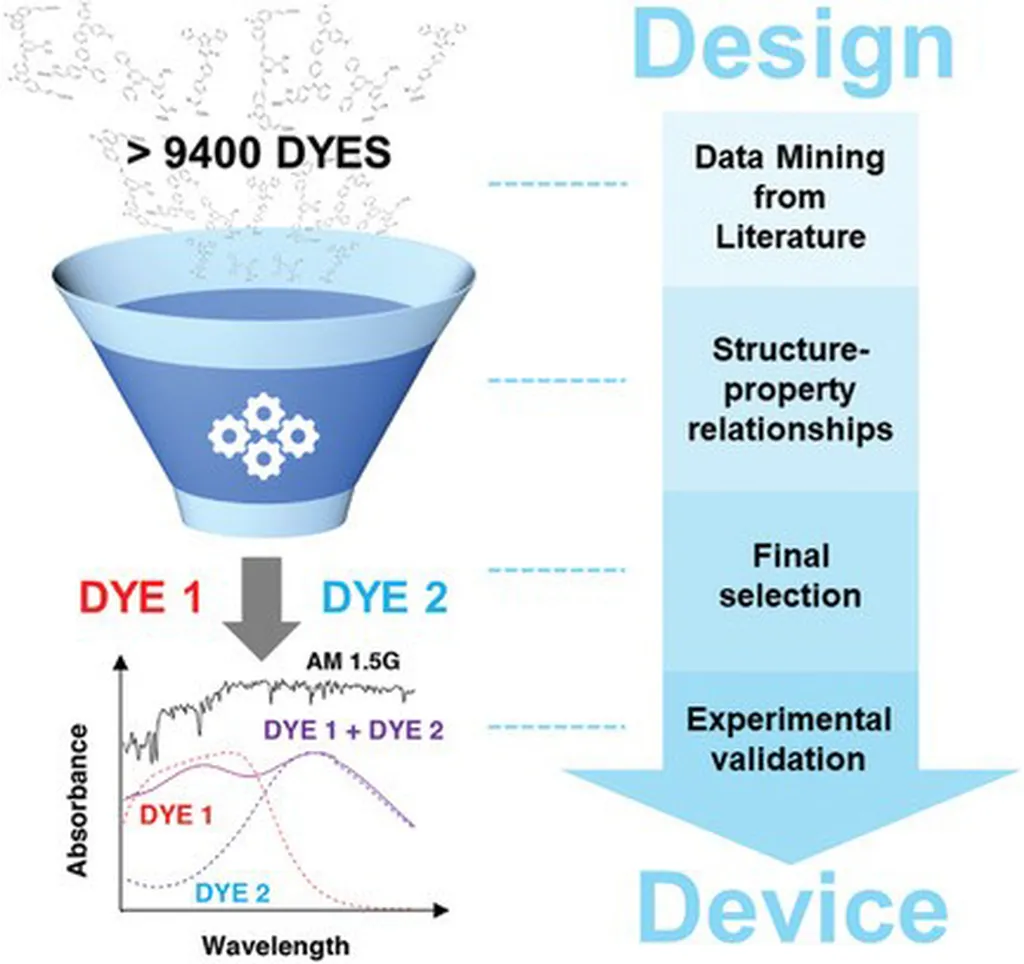
In the realm of sustainable energy research, a team of scientists from various institutions, including Md Mahmudul Hasan, Chiara Bordin, Fairuz Islam, Tamanna Tasnim, Md. Athar Ishtiyaq, Md. Tasin Nur Rahim, and Dhrubo Roy, have made significant strides in the development of novel organic dyes for dye-sensitized solar cells (DSSCs). Their work, published in the Journal of Physical Chemistry C, leverages computational design to enhance the efficiency of these solar cells, offering promising avenues for the energy sector.
The researchers focused on metal-free porphyrin-based dyes, which are crucial components in DSSCs. By introducing various donor and acceptor groups to the porphyrin structure, they created fifteen unique dyes. Using advanced computational methods, specifically density functional theory (DFT) and time-dependent DFT (TD-DFT), the team optimized the ground state geometries and explored the excited state optical properties of these dyes. The calculations were performed using the 6-311G(d,p) basis set, with tetrahydrofuran (THF) as the solvent.
The study revealed that the highest occupied molecular orbital (HOMO) energy levels of most modified dyes were lower than the redox potential of I-/I3-, while the lowest unoccupied molecular orbital (LUMO) energy levels were higher than the conduction band of TiO2. This is a critical finding, as it indicates that these dyes can effectively facilitate charge separation and transfer, which are essential processes in solar energy conversion.
Among the fifteen dyes, one particular dye, labeled N1, stood out due to its superior optoelectronic properties. Dye N1, which uses a triphenylamine group as the donor and a p-ethynylbenzoic acid group as the acceptor, demonstrated the highest power conversion efficiency (PCE) of 14.37%. This efficiency is a significant improvement over existing dyes and makes N1 a promising candidate for practical applications in the DSSC industry.
Beyond the discovery of new materials, this research underscores the importance of high-performance computing in the energy sector. The predictive screening of dye candidates and the generation of performance indicators, such as HOMO-LUMO gaps, absorption spectra, and photovoltaic metrics, can greatly inform energy informatics and system modeling. These insights can guide decision-making processes, ultimately leading to more efficient and sustainable energy solutions.
In summary, the work of Hasan and his colleagues represents a significant advancement in the field of sustainable energy. By leveraging computational design, they have identified a novel dye that could enhance the efficiency of DSSCs, bringing us closer to a future powered by clean, renewable energy. The research was published in the Journal of Physical Chemistry C, a reputable source for cutting-edge scientific research.
This article is based on research available at arXiv.