
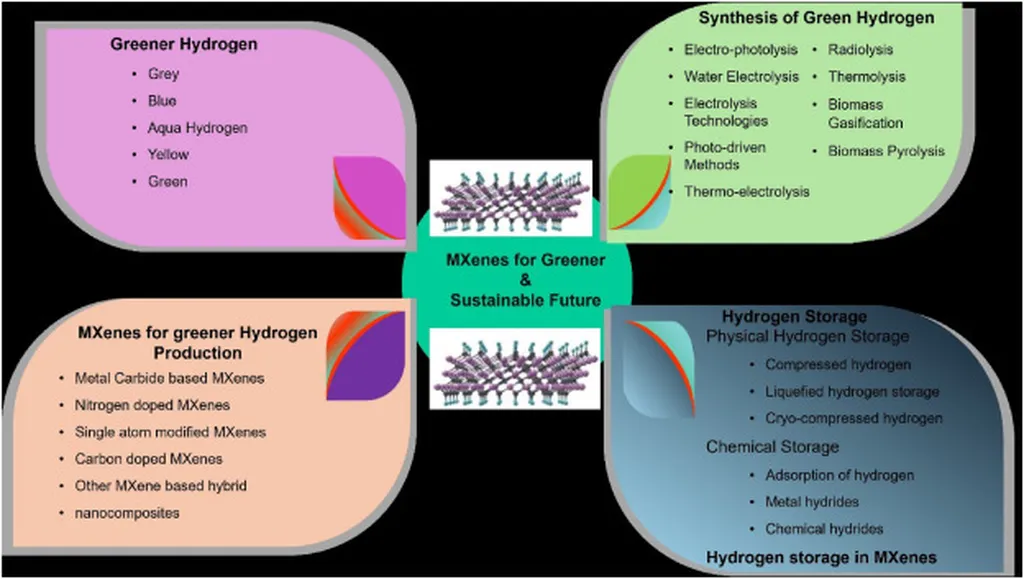
In a significant stride towards sustainable hydrogen energy technologies, a team of researchers from various institutions, including the Max-Planck-Institut für Eisenforschung GmbH and the Technion – Israel Institute of Technology, has developed a novel method for fabricating self-supported MXene electrodes. This innovation could potentially revolutionize the energy industry by enhancing the efficiency and durability of electrochemical hydrogen production.
MXenes, a class of two-dimensional materials known for their high conductivity and catalytic potential, have long been touted for their promise in electrochemical applications. However, their use in bulk electrode form has remained largely unexplored until now. The researchers, led by Rebeca Miyar and Bar Favelukis, have presented a methodology for creating self-supported van der Waals solid Ti3C2Tz MXene electrodes. This process involves cold compaction followed by vacuum heat treatment at 600 °C, which effectively removes interlayer confined water and stabilizes the bulk 3D structure.
The resulting binder-free electrodes exhibit enhanced mechanical robustness and structural and chemical stability in various electrolytes. These electrodes demonstrate adequate hydrogen evolution reaction (HER) activity while maintaining electrochemical stability over time, with minimal oxidation or changes in termination surface chemistry. This approach is scalable and cost-effective, overcoming limitations of nanoscale MXene architectures in electrochemical environments.
The practical applications for the energy sector are substantial. The enhanced mechanical integrity and electrochemical stability of these MXene electrodes could lead to more efficient and durable hydrogen production systems. This could, in turn, facilitate the broader adoption of hydrogen as a clean and sustainable energy source. The research was published in the journal Nature Communications, a reputable source for cutting-edge scientific findings.
This article is based on research available at arXiv.