
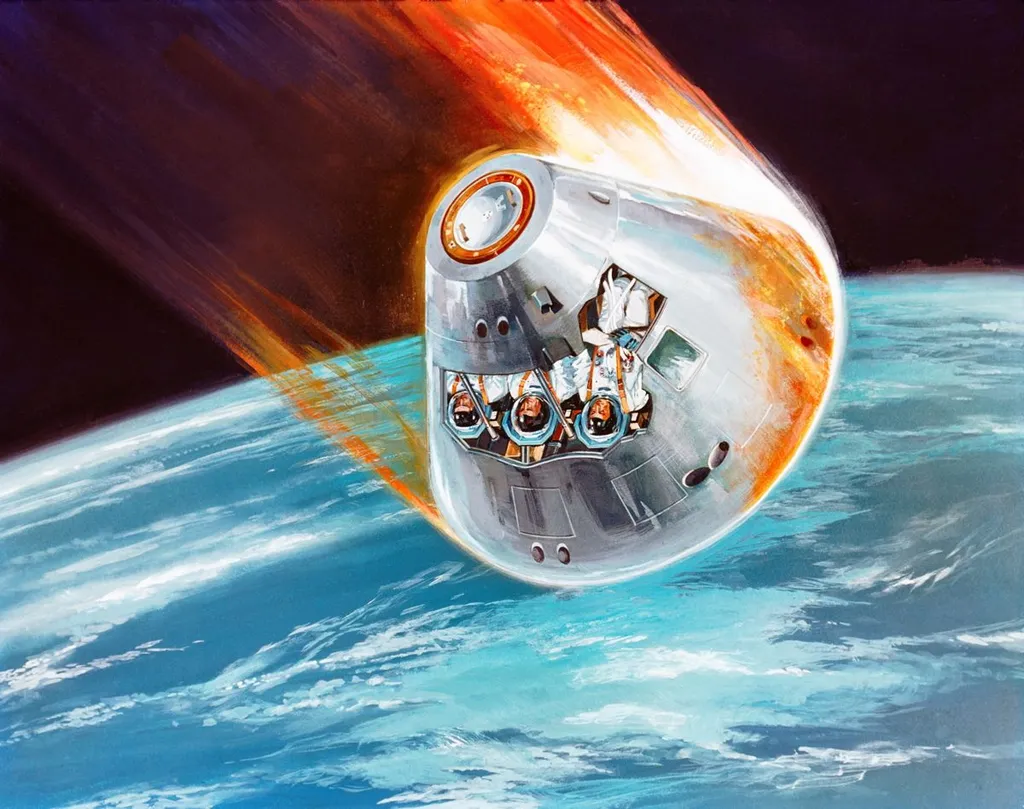
Felipe Martin Rodriguez Fuentes and Bernard Parent, researchers from the University of Michigan, have been studying ways to mitigate communication blackouts experienced by re-entry vehicles. Their work, published in the Journal of Spacecraft and Rockets, focuses on using pulsed electric fields to deplete electron density in plasma flows, thereby reducing signal attenuation.
When spacecraft re-enter Earth’s atmosphere, a plasma layer forms around them, causing a communication blackout. This plasma layer absorbs and scatters radio waves, making it difficult for ground stations to receive telemetry data from the vehicle. Fuentes and Parent’s research aims to address this critical telemetry gap.
The researchers conducted fully-coupled simulations of high-voltage pulsed discharges interacting with a Mach 24 flowfield. They found that applying an electric field generates a large, non-neutral plasma sheath near the cathode. This sheath depletes electron density by several orders of magnitude over a distance comparable to the height of the shock layer. The resulting depletion window significantly reduces the attenuation of a 4 GHz signal from 60% to 4%, with a power requirement of 66 W per cm² of exposed cathode surface.
The study also revealed that the sheath topology is primarily governed by ion kinetics. Specifically, corrections to ion mobility at high reduced electric fields lead to enhanced space-charge shielding and a subsequent contraction of the sheath. Conversely, the sheath structure is largely insensitive to the electron mobility model.
Fuentes and Parent argue that their drift-diffusion model likely provides a conservative lower bound for mitigation performance. A kinetic approach accounting for ballistic ion transport and non-local ionization would likely predict thicker sheaths and lower attenuation for equivalent power deposition.
This research has practical applications for the energy sector, particularly in the development of advanced spacecraft and re-entry vehicles. By mitigating communication blackouts, this technology could improve the safety and efficiency of space missions, ultimately contributing to the growth of the space industry and its energy-related applications.
This article is based on research available at arXiv.