
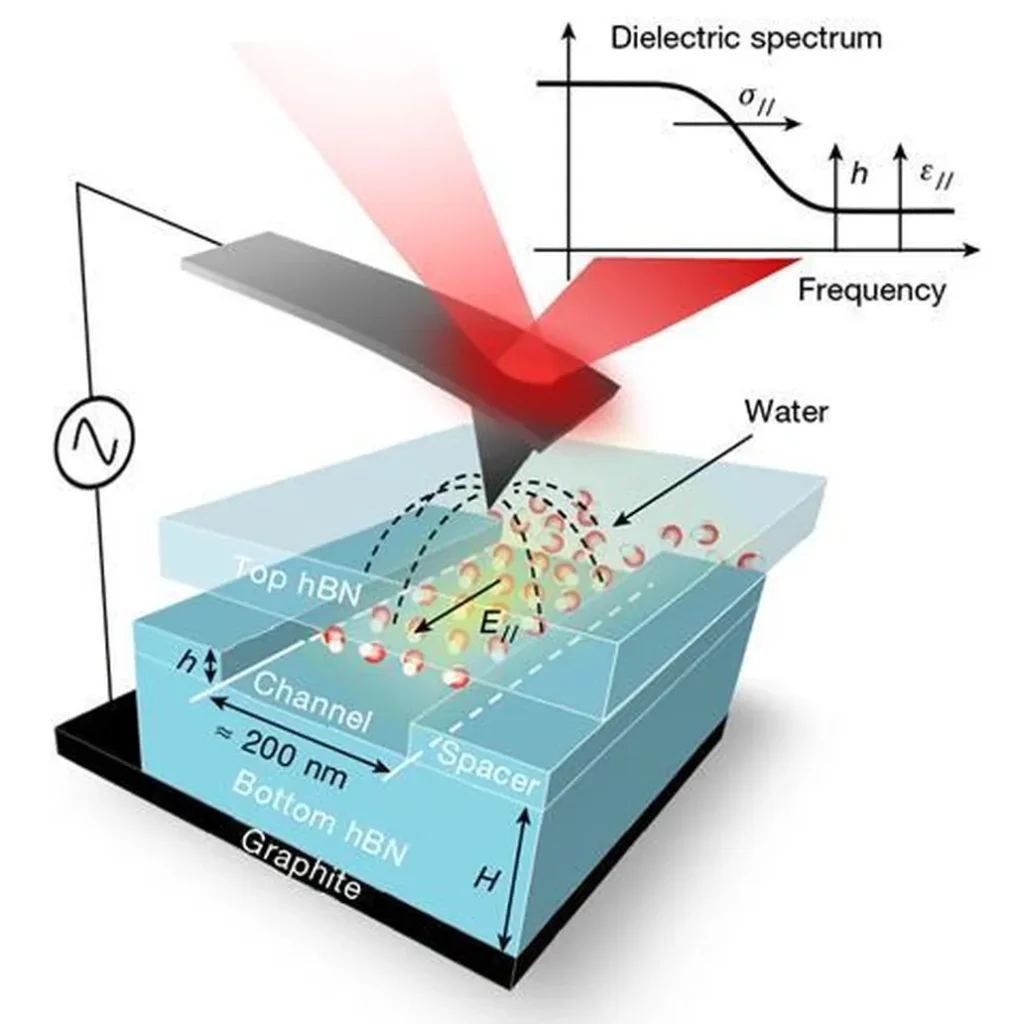
Researchers Chenyu Wang, Wanjian Yin, and Ke Zhou from the University of Science and Technology of China have recently published a study in the journal Nature Communications that sheds light on how water behaves when confined to extremely small spaces, a phenomenon that could have significant implications for the energy industry.
The study focuses on water’s ability to self-dissociate into H₃O⁺ and OH⁻ ions, a process central to acid-base chemistry and bioenergetics. By using advanced computational methods, the researchers found that when water is confined to a single molecular layer, it exhibits a markedly lower barrier to auto-dissociation than bulk water. This means that water in such confined spaces can more easily dissociate into ions, a process crucial for various chemical reactions.
The researchers attribute this enhanced dissociation to the restructuring of both intramolecular bonding and the intermolecular hydrogen-bond network. Confinement enforces quasi-2D dipolar correlations that amplify dielectric fluctuations, making the water a superdielectric medium. This could lead to superionic behavior, where the water exhibits high proton conductivity, a property highly sought after in the energy industry for applications such as fuel cells and batteries.
The findings suggest that confinement could be a powerful tool to enhance proton activity, which could have practical applications in nanofluidic systems, geochemical niches, and biomolecular environments. For the energy sector, this research could pave the way for the development of more efficient energy storage and conversion devices, as well as a better understanding of electrochemical processes in confined spaces.
In summary, the study provides valuable insights into the behavior of water at the nanoscale, highlighting the potential of confinement to enhance proton activity. This could open up new avenues for the development of advanced energy technologies, making it a significant contribution to the field of energy research.
This article is based on research available at arXiv.