
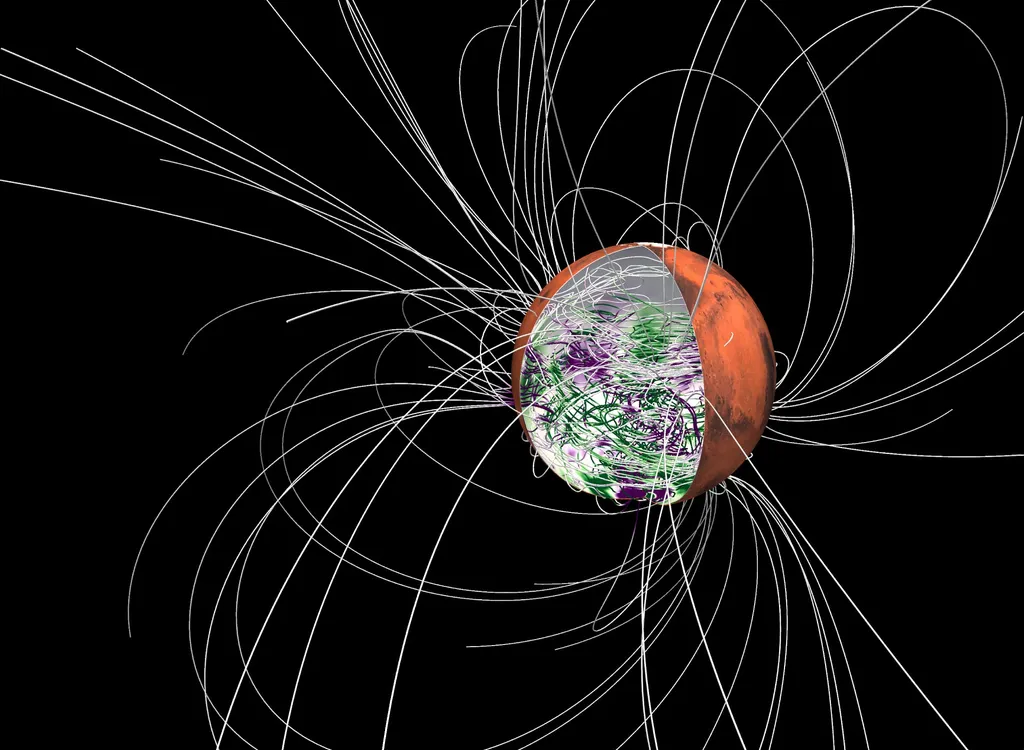
In the realm of space physics and planetary science, a team of researchers led by Zhihao Cheng from the University of Science and Technology of China, along with collaborators from the University of Texas at Arlington and the Chinese Academy of Sciences, has delved into the intricacies of Mars’ induced magnetic field. Their work, published in the journal Geophysical Research Letters, offers new insights into how the Red Planet interacts with the solar wind, a stream of charged particles emanating from the Sun.
Mars, unlike Earth, does not possess a global intrinsic dipole magnetic field. Instead, its interaction with the solar wind generates a global induced magnetosphere. Previous studies have largely relied on single-spacecraft measurements, which could not simultaneously capture upstream solar wind conditions and the induced magnetic fields. This limitation has hindered a comprehensive understanding of the system.
The researchers utilized coordinated observations from NASA’s MAVEN (Mars Atmosphere and Volatile Evolution) mission and China’s Tianwen-1 mission to incorporate real-time upstream solar wind conditions into their analysis. Their findings reveal that both the solar wind dynamic pressure and the interplanetary magnetic field (IMF) magnitude enhance the strength of the induced magnetic field. However, these factors exert opposite effects on the compression ratio: higher dynamic pressure strengthens compression, while a stronger IMF weakens it.
The study also found that the induced field is stronger under quasi-perpendicular IMF conditions compared to quasi-parallel IMF, indicating a stronger mass-loading effect. The researchers further investigated the clock angle departures of the induced fields, which are measures of the angular difference between the induced magnetic field and the IMF. They observed that these departures remain relatively small in the magnetosheath near the bow shock, increase gradually toward the induced magnetosphere, and become significantly larger within the induced magnetosphere.
Moreover, clock angle departures are strongly enhanced under quasi-parallel IMF conditions. The dependence of these departures on upstream drivers shows that, within the magnetosheath, they are minimized under low dynamic pressure, high IMF magnitude, and low Alfven Mach number conditions. These results underscore the critical role of multi-point observations in enhancing our understanding of solar wind interaction with Mars.
While this research primarily advances our scientific understanding of Mars’ magnetosphere, it also has practical implications for the energy sector. Understanding the interaction between solar wind and planetary bodies can inform the development of technologies to protect spacecraft and infrastructure from space weather events. This knowledge can be particularly valuable for designing and operating satellites and other energy-related systems in space, ensuring their resilience against the harsh conditions of the solar wind.
In summary, the study by Cheng and colleagues provides a more nuanced picture of Mars’ induced magnetic field and its interaction with the solar wind. By leveraging multi-point observations, the researchers have uncovered new details that could enhance our understanding of planetary magnetospheres and contribute to the development of more robust space technologies.
This article is based on research available at arXiv.