
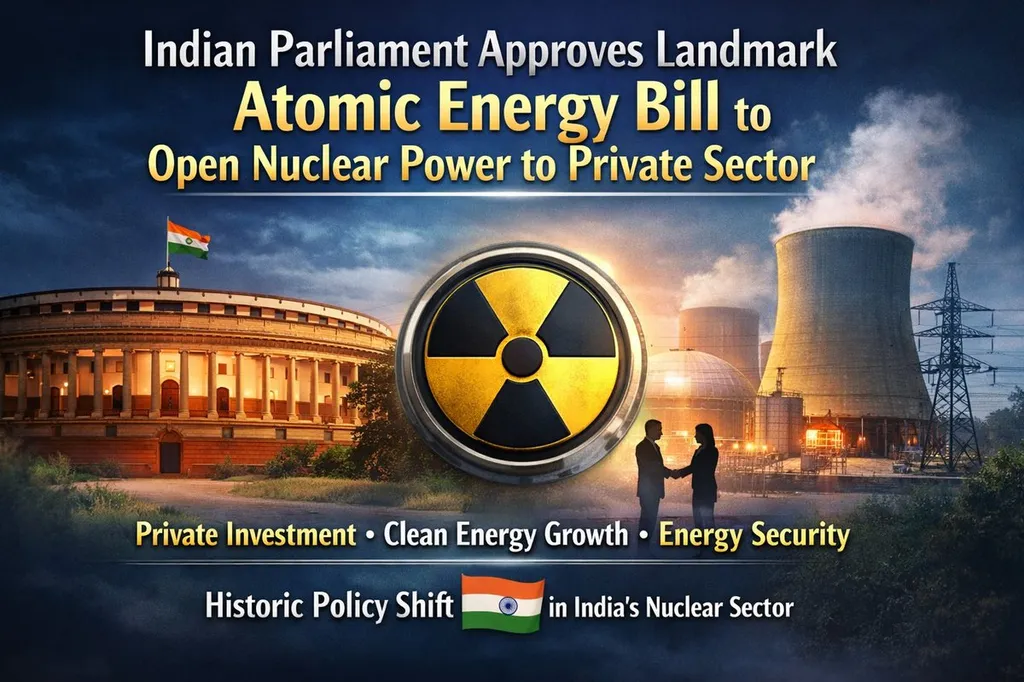
India’s Parliament last week approved groundbreaking legislation to open the country’s tightly controlled civil nuclear power sector to private companies, marking a decisive shift in the nation’s energy policy and a bold step toward accelerating clean energy expansion. The move, which amends decades-old laws that reserved nuclear energy development exclusively for state-owned entities, is designed to modernize India’s nuclear framework, attract private investment, and align with global benchmarks for safety, security, and technological advancement. The bill, now awaiting presidential assent, is expected to catalyze the development of next-generation nuclear technologies, including small modular reactors, and position India as a major player in the global nuclear renaissance.
The new law retains and strengthens core safety and regulatory safeguards while enabling private sector participation in nuclear power generation—a sector previously monopolized by the state. This policy shift is part of India’s broader strategy to reduce dependence on fossil fuels, which currently account for over 75% of the country’s electricity generation. The government has pledged to install 100 gigawatts of nuclear capacity by 2047, enough to power nearly 60 million homes annually. “It marks a momentous milestone for India and signals capable private sector players that the country is open for business in the nuclear energy space,” said Karthik Ganesan, director of strategic partnerships at the Council on Energy, Environment and Water.
The legislation addresses longstanding challenges in India’s energy sector, where nuclear power has remained a small but critical component of the energy mix. By inviting private investment, the government aims to overcome bottlenecks in financing, technology transfer, and project execution that have historically constrained nuclear expansion. Junior Minister Jitendra Singh, overseeing the Department of Atomic Energy, emphasized that the bill “seeks to modernize India’s nuclear framework in line with technological, economic, and energy realities,” while ensuring that safety and security remain paramount. Critics, however, warn that privatization could dilute safety standards and increase risks, particularly in a country with a history of public skepticism toward nuclear energy.
The broader implications of this policy shift extend beyond India’s borders. As nations worldwide reassess nuclear power’s role in meeting climate targets and ensuring energy security, India’s move could serve as a model for balancing private sector dynamism with robust regulatory oversight. The legislation also underscores the growing recognition that, alongside renewables, nuclear energy is essential for achieving net-zero emissions, especially in countries with surging electricity demand. “India’s role in geopolitics is increasing. And if we have to be a global player effectively, we have to live up to global benchmarks, follow global parameters, and adopt global strategies,” Singh told lawmakers.
For the global energy sector, India’s nuclear privatization could spur innovation, reduce costs, and accelerate the deployment of advanced reactor designs. It may also intensify competition among international vendors and investors, potentially driving down technology costs and improving supply chain resilience. However, the success of this policy will hinge on effective implementation, transparent regulation, and the ability to address public concerns about safety and environmental risks. If executed well, India’s nuclear gambit could redefine the energy landscape in Asia and beyond, offering a scalable blueprint for integrating nuclear power into the clean energy transition.