
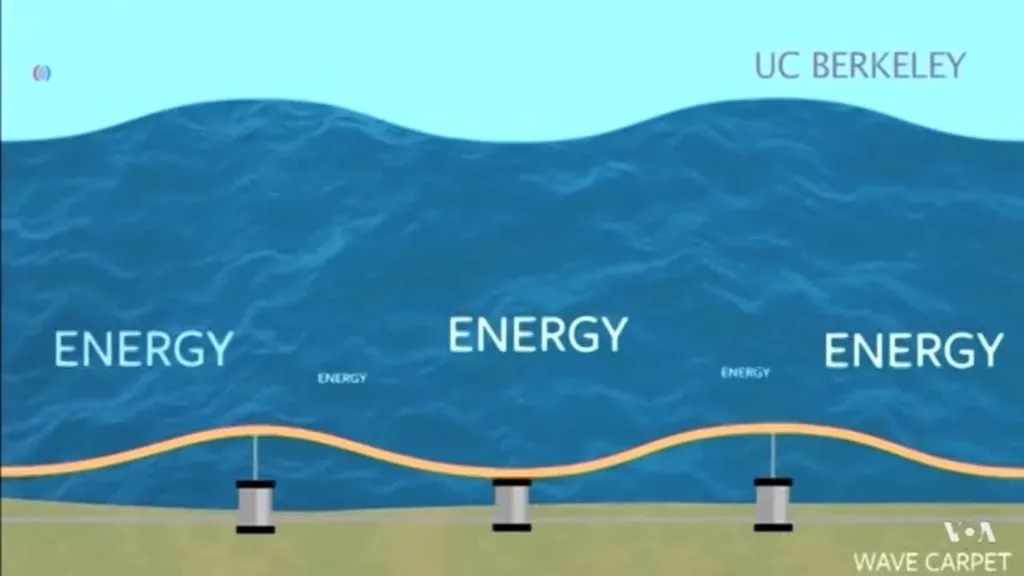
Researchers from the University of Wollongong and the University of Melbourne, led by Zachary J. Wegert, have published a study investigating the potential of piezoelectric materials to convert wave energy into electricity. Their work focuses on understanding how flexible piezoelectric structures interact with ocean waves, aiming to develop compact and efficient wave-energy converters.
The study explores the use of piezoelectric plates, which consist of two piezoelectric layers separated by an elastic substrate, to absorb energy from ocean waves. The researchers derived the equations of motion for these plates and developed a novel solution method to solve these equations. This method can be applied to various types of plates, including rigid, flexible elastic, or flexible piezoelectric plates, submerged or floating.
The researchers conducted extensive numerical simulations to evaluate the energy absorption capabilities of these piezoelectric plates under different conditions. They found that submerged plates absorbed more energy than those floating on the surface. Additionally, plates with clamped boundaries absorbed slightly more energy than those with simply supported boundaries. The study compared the performance of two different piezoelectric materials: polyvinylidene fluoride (PVDF) and lead zirconate titanate (PZT-5H).
The practical applications of this research for the energy sector include the development of compact and efficient wave-energy converters. These devices could harness renewable energy from the marine environment, contributing to a more sustainable energy mix. The researchers have made their open-source code available to facilitate further research and development in this area.
The study was published in the Journal of Applied Physics, a peer-reviewed scientific journal covering research on the practical applications of physics.
This article is based on research available at arXiv.