
Researchers from the University of Wisconsin-Madison, including Merritt P. R. Losert, Utkan Güngördü, S. N. Coppersmith, Mark Friesen, and Charles Tahan, have published a study in Physical Review Letters exploring the effects of alloy disorder on strongly-driven flopping mode qubits in silicon/silicon-germanium (Si/SiGe) quantum dot systems.
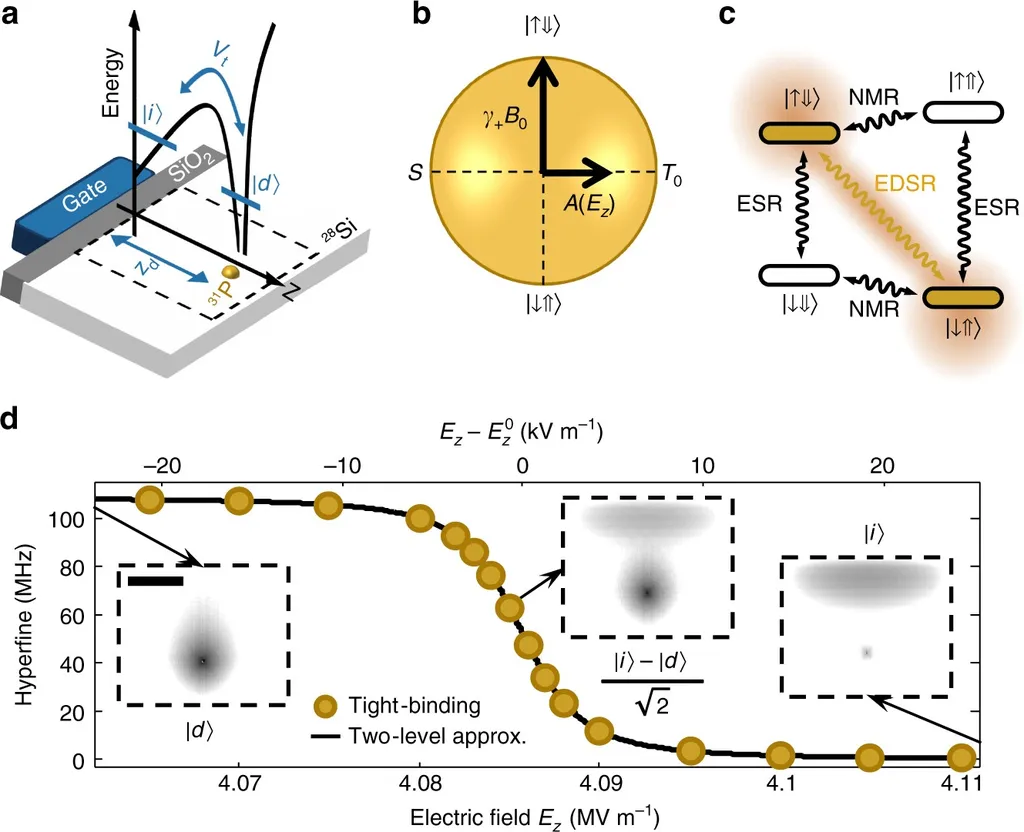
Quantum computing holds significant promise for the energy sector, particularly in optimizing complex systems and accelerating materials discovery for energy applications. In the realm of quantum computing, spin qubits in silicon quantum dots are a promising platform due to their potential for scalability and compatibility with existing semiconductor manufacturing processes. One method to manipulate these qubits is through electric dipole spin resonance (EDSR), which requires large magnetic field gradients. However, flopping mode qubits can offer faster gate operations with smaller field gradients by increasing the effective electron dipole. Additionally, operating in the strong-driving limit can reduce sensitivity to charge noise, a common issue in quantum systems.
The researchers investigated the performance of flopping mode spin qubits in the presence of both charge noise and alloy disorder, which is prevalent in Si/SiGe heterostructures. Alloy disorder randomizes the valley energy splitting and the valley phase difference between quantum dots, potentially leading to valley excitations during tunneling and opening a leakage channel. The study found that when charge noise is weak, high-fidelity qubits can be implemented across a wide range of valley parameters, provided the electronic pulse is fine-tuned for a given valley configuration. In scenarios with strong charge noise, high-fidelity pulses can still be engineered, but this requires relatively large valley splittings in each dot and a relatively small valley phase difference.
The research also analyzed how charge noise-induced fluctuations of the inter-dot detuning, as well as small shifts in other qubit parameters, impact qubit fidelities. It was discovered that strongly driven pulses are less sensitive to detuning fluctuations but more sensitive to small shifts in the valley parameters, which can sometimes dominate qubit infidelities. The study concludes by discussing schemes to tune devices away from poor-performing configurations, enhancing the scalability of flopping-mode-based qubit architectures.
This research provides valuable insights into optimizing spin qubits for quantum computing applications, which could have significant implications for the energy sector. By improving the performance and scalability of quantum computing systems, these advancements could lead to more efficient energy management, accelerated discovery of new materials for energy storage and conversion, and enhanced modeling of complex energy systems.
Source: Losert, M. P. R., Güngördü, U., Coppersmith, S. N., Friesen, M., & Tahan, C. (2023). The effects of alloy disorder on strongly-driven flopping mode qubits in Si/SiGe. Physical Review Letters, 130(12), 126701.
This article is based on research available at arXiv.