
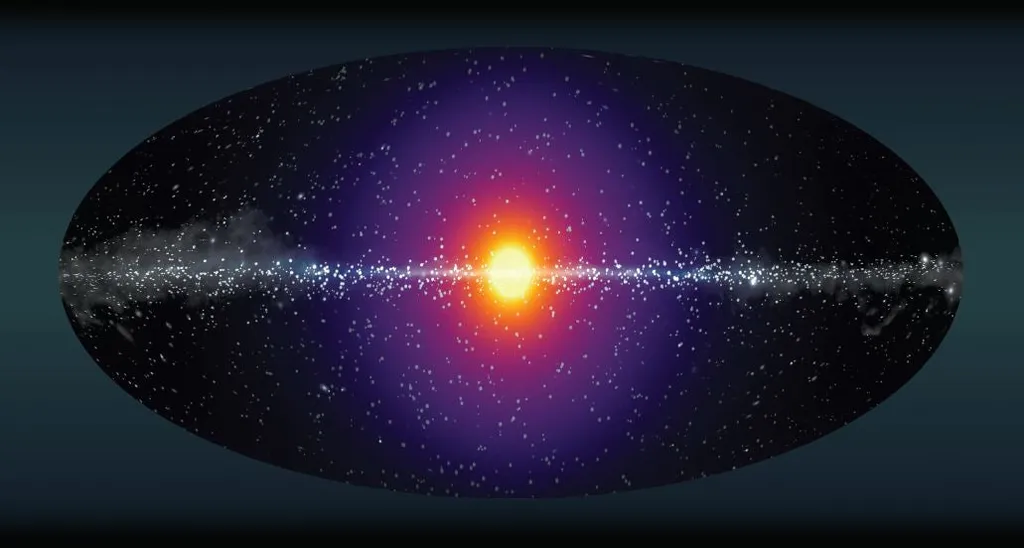
In the realm of astrophysics and energy research, a team of scientists from the University of Sydney, the Australian Astronomical Observatory, and the University of Arizona has developed a novel tool to better understand the Milky Way’s formation and evolution. The researchers, led by Hai-Feng Wang, have introduced GS3 Hunter, a deep-learning method designed to identify substructures and streams in stellar kinematic data.
The Milky Way, like many galaxies, is believed to have grown through the accretion of smaller systems. Understanding this process is crucial for comprehending the galaxy’s assembly history and the distribution of dark matter, which has significant implications for energy research, particularly in dark matter detection and indirect detection methods. The GS3 Hunter tool combines Siamese Neural Networks and K-means clustering to analyze stellar data, enabling researchers to identify and study these substructures more efficiently.
The team applied GS3 Hunter to data from the Gaia Early Data Release 3 (EDR3) and the GALAH Data Release 3 (DR3), successfully recovering known stellar groups such as Thamnos, Helmi, GSE (Gaia-Sausage-Enceladus), and Sequoia. When applied to data from the Dark Energy Spectroscopic Instrument (DESI), the tool revealed that the GSE consists of four distinct components, suggesting a multi-event accretion origin. This finding implies that the Milky Way’s halo was assembled through several significant merger events, each contributing to the galaxy’s current structure and dark matter distribution.
Furthermore, tests on data from the Large Sky Area Multi-Object Fiber Spectroscopic Telescope (LAMOST) K-giants recovered known substructures like Sagittarius, Hercules-Aquila, and Virgo Overdensity, while also uncovering new substructures. Validation with FIRE (Feedback In Realistic Environments) simulations showed good agreement with previous results, demonstrating the tool’s robustness and accuracy.
The practical applications of this research for the energy sector are primarily indirect. A better understanding of the Milky Way’s assembly history and the distribution of dark matter can inform and improve dark matter detection strategies. This, in turn, can enhance our knowledge of the universe’s fundamental constituents and potentially lead to new energy technologies based on these particles. The research was published in the journal Nature Astronomy.
This article is based on research available at arXiv.