
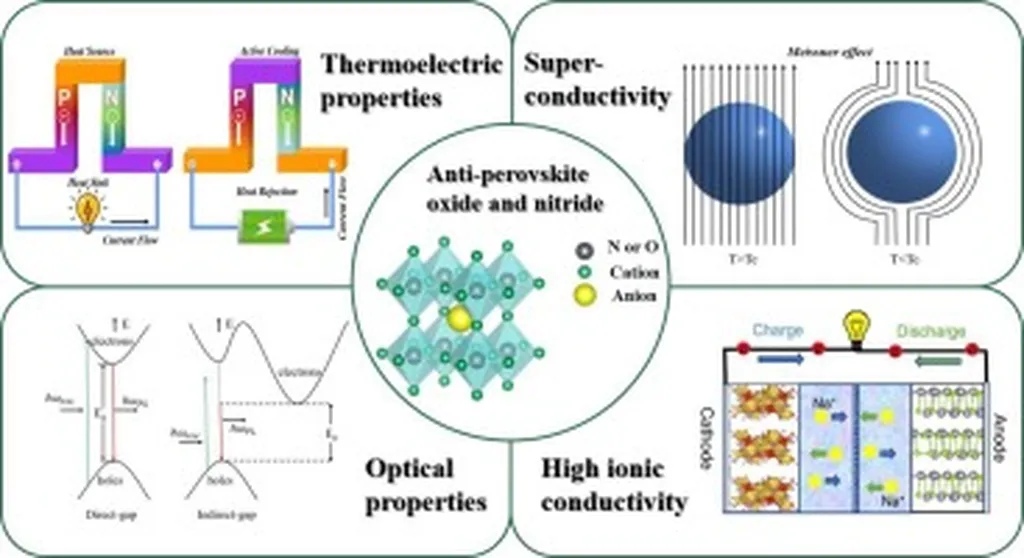
Researchers from the University of Science and Technology of China have made significant strides in understanding the properties of antiperovskite nitrides, a class of materials that could have implications for the energy sector, particularly in the development of advanced electronic and energy conversion devices. The team, led by Professor Er-Jia Guo, has published their findings in the journal Nature Communications.
The researchers successfully synthesized thin films of Ni3InN, a type of antiperovskite nitride, on various substrates with different lattice constants. This synthesis was guided by first-principles phonon calculations that confirmed the dynamical stability of the cubic phase of Ni3InN. The team employed high-resolution scanning transmission electron microscopy to examine the interfaces between the Ni3InN films and the substrates. They observed coherent (001)-oriented interfaces when Ni3InN was grown on LaAlO3 and SrTiO3 substrates. However, an unexpected (011)-orientation formed on DyScO3, aligning with surface-energy predictions.
Transport measurements revealed that the electronic properties of Ni3InN are highly sensitive to strain. The researchers observed a strain-controlled Fermi-liquid behavior, which is correlated with variations in the Ni-3d bandwidth and hybridization. Band structure calculations further elucidated the electronic properties of Ni3InN, revealing a dual character near the Fermi level. This includes a high-mobility Dirac-like band and a Ni-3d manifold that drives strange-metal transport with a reduced slope compared to oxide perovskites.
The formal Ni valence of +2/3 places Ni3InN in an overdoped correlated-metal regime, distinguishing it from most perovskite oxides. This unique electronic behavior positions antiperovskite nitrides as a promising platform for investigating overdoped Fermi liquids and strange-metal behavior. The findings could have practical applications in the energy sector, particularly in the development of advanced electronic devices and energy conversion technologies that rely on the precise control of electronic properties.
The research highlights the potential of antiperovskite nitrides as a new class of materials for exploring novel electronic phenomena and developing next-generation energy technologies. The team’s work provides a foundation for further investigation into the properties and applications of these materials, paving the way for innovative solutions in the energy industry.
Source: Nature Communications
This article is based on research available at arXiv.