
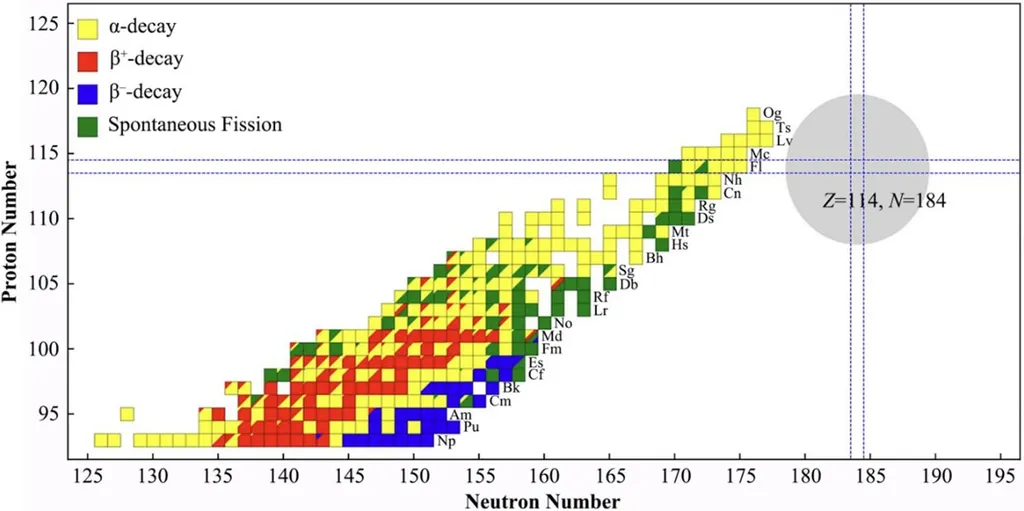
In the realm of nuclear physics, a team of researchers from the Institute of Modern Physics at the Chinese Academy of Sciences has made significant strides in understanding the delicate balance of spontaneous fission in superheavy nuclei, specifically the isotope Rf-252. Their work, published in the journal Physical Review Letters, sheds light on the mechanisms that govern the stability and decay of these exotic nuclei.
The researchers, Zhen-Zhen Zhang, Hua-Lei Wang, Kui Xiao, and Min-Liang Liu, have delved into the intricate balance of the spontaneous fission process in Rf-252, which has a lifetime of less than a microsecond. Their study builds upon a recent experimental discovery of this short-lived nucleus, providing a deeper theoretical understanding of its behavior.
The team performed advanced calculations to map out the potential energy surface of Rf-252, revealing the mechanisms behind its enhanced stability. They identified a high-spin isomeric state, characterized by a specific nuclear shape and orientation, which contributes to the nucleus’s stability. This isomeric state, with a spin of 6 units of angular momentum (denoted as 6+), is thought to be built upon a shape isomeric state, adding another layer of complexity to the nucleus’s behavior.
The researchers explored various deformation effects, such as triaxial deformation (γ), reflection-asymmetry (β3), and high-order deformations (β6), on both the ground state and the isomeric state of Rf-252. They found that these deformations play crucial roles in shaping the potential energy curves along the fission valley, which is the path the nucleus follows as it undergoes fission.
One of the key findings of this study is the possibility of multipath decay from the high-spin isomeric state. This means that the nucleus can decay through multiple pathways, each with its own potential energy surface. These pathways can reduce the nuclear lifetime and balance the fission stability, providing a new perspective on the decay mechanisms of superheavy nuclei.
The results of this research not only elucidate the enhanced stability of the high-spin isomeric state but also highlight the limitations of this stability increase. Understanding these mechanisms is crucial for the energy sector, particularly in the context of nuclear energy and the development of advanced nuclear fuels. The insights gained from this study can contribute to the design of more stable and efficient nuclear systems, ultimately enhancing the safety and sustainability of nuclear energy production.
In summary, the work of Zhang, Wang, Xiao, and Liu provides a detailed theoretical framework for understanding the spontaneous fission process in superheavy nuclei, with significant implications for the energy sector. Their findings, published in Physical Review Letters (Phys. Rev. Lett. 134 (2025) 022501), offer valuable insights into the complex behavior of these exotic nuclei and pave the way for future advancements in nuclear energy technology.
This article is based on research available at arXiv.