
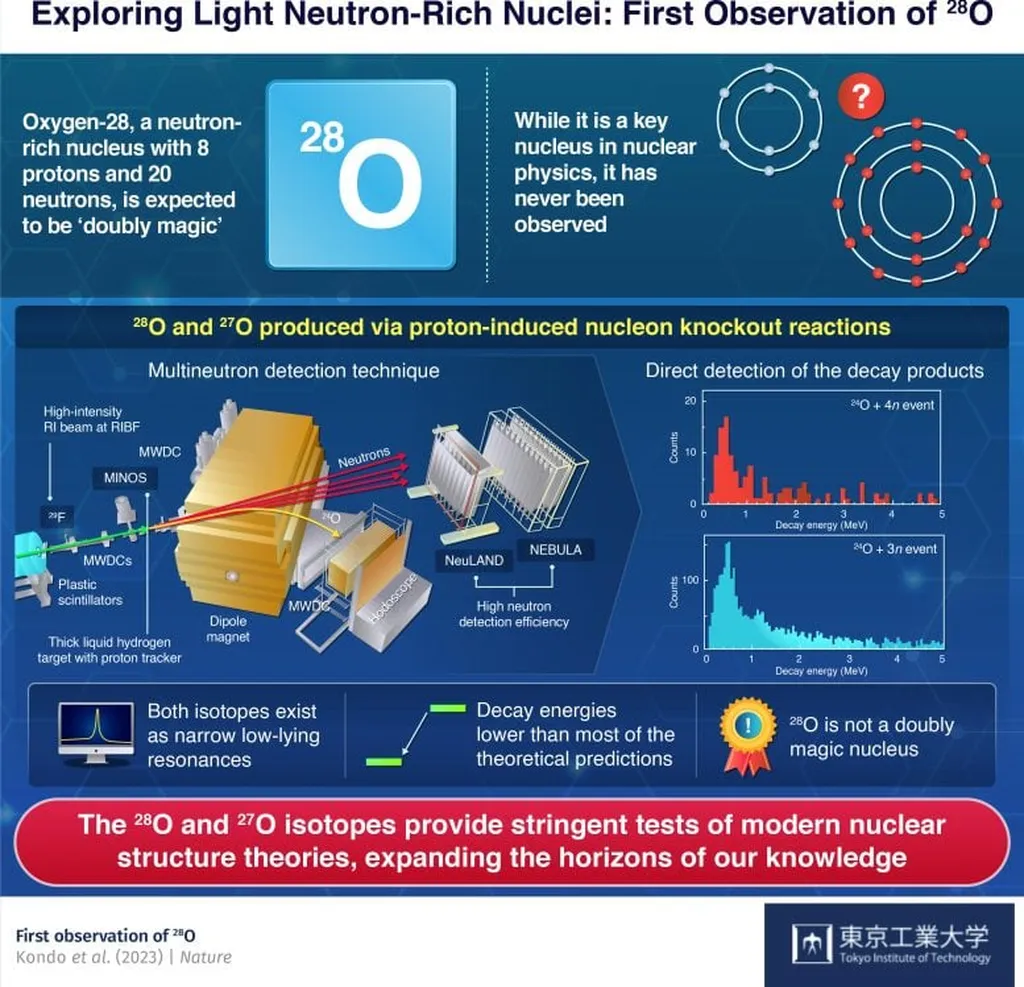
In the realm of nuclear physics, a team of researchers from the Helmholtz Institute for Radiation and Nuclear Physics at the University of Bonn, Germany, has been delving into the mysteries of multi-neutron systems. Led by Shuang Zhang, along with Serdar Elhatisari and Ulf-G. Meißner, the team has been exploring the structure and behavior of neutron-rich light nuclei, particularly ${}^8$He and ${}^7$H. Their findings, published in the journal Physical Review Letters, offer valuable insights that could have implications for the energy sector, particularly in understanding nuclear reactions and improving nuclear energy technologies.
The quest to understand multi-neutron systems has been ongoing for some time, with recent experimental efforts focusing on probing candidate four-neutron configurations in neutron-rich light nuclei. However, the ground-state energies of certain hydrogen isotopes, such as ${}^6$H and ${}^7$H, have not been well constrained, leading to discrepancies in both experimental analyses and theoretical predictions.
To address this, the researchers employed ab initio nuclear lattice effective field theory, utilizing an ensemble of 282 chiral two- and three-nucleon forces. This approach allowed them to perform an uncertainty-quantified analysis of the ground-state energies of ${}^6$H and ${}^7$H. Their findings suggest a single-neutron separation energy for ${}^7$H of approximately 0.35 MeV, with an uncertainty of plus or minus 0.32 MeV. This result disfavors the sequential decay of ${}^6$H + n and instead points towards direct t + 4n emission.
The researchers also examined the intrinsic densities of these nuclei, revealing triton- and α-like clusters in ${}^7$H and ${}^8$He, respectively. By computing two-body and reduced four-body correlation functions, they found that the valence neutrons in the surface region of these systems form compact dineutrons. These dineutrons predominantly organize into symmetric dineutron-dineutron configurations, with a smaller fraction assembling into more compact tetraneutron-like substructures. In ${}^7$H, these components account for roughly 95% and 5% of the sampled four-neutron configurations, respectively, with ${}^8$He exhibiting a similar hierarchy.
The spatial and angular correlation patterns among the nucleons were also extracted for these configurations. These results provide nuclear-structure insights into the debate surrounding four-neutron clusters and complement ongoing experimental searches for tetraneutron signatures in light nuclei.
For the energy sector, a deeper understanding of nuclear structure and reactions can lead to advancements in nuclear energy technologies. This research contributes to the fundamental knowledge required for developing safer, more efficient nuclear reactors and improving nuclear waste management. Additionally, insights into neutron-rich nuclei can enhance our understanding of stellar nucleosynthesis, which is crucial for energy production in stars and has implications for nuclear astrophysics.
In summary, the work of Zhang, Elhatisari, and Meißner offers valuable insights into the structure of neutron-rich light nuclei, with potential applications in the energy sector. Their findings, published in Physical Review Letters, contribute to the ongoing quest to understand multi-neutron systems and their role in nuclear reactions and energy production.
This article is based on research available at arXiv.