
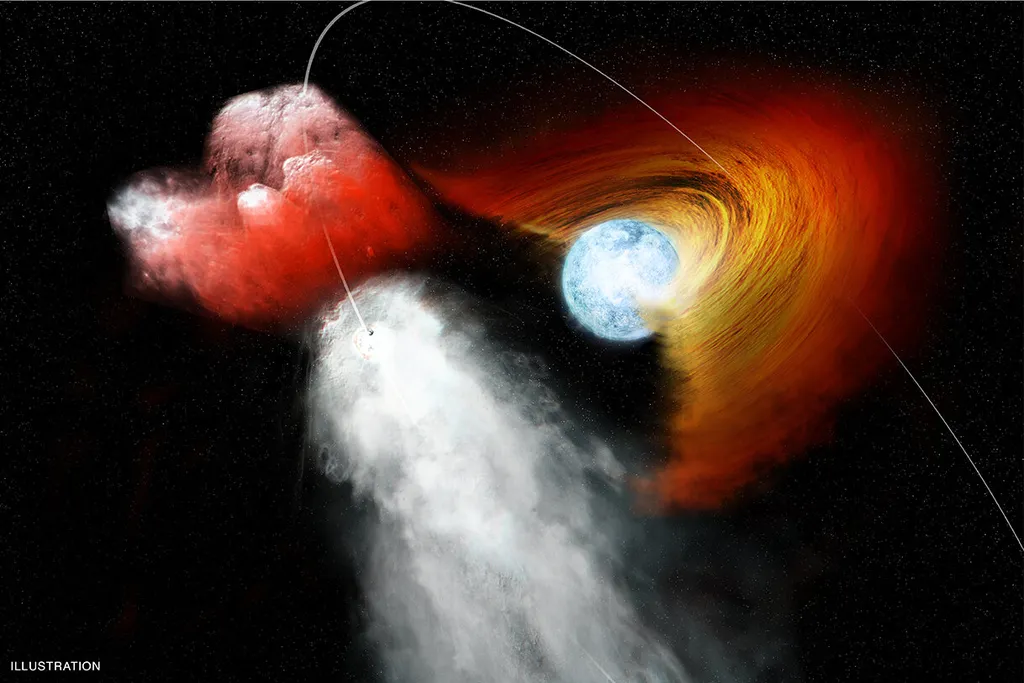
In the realm of astrophysics and energy research, the study of binary star systems can offer valuable insights into stellar evolution and energy dynamics. Leading this intricate exploration is Dr. I. I. Antokhin, a researcher affiliated with a prominent institution in the field. His recent study, published in the esteemed journal Astronomy & Astrophysics, delves into the period change of the binary system WR+O V444 Cyg, providing updated ephemeris formula and shedding light on the mass-loss rate of Wolf-Rayet stars.
V444 Cyg is a binary system comprising a Wolf-Rayet star (WR) of type WN5 and an O-type star (O6 V). This system is notable for its eclipsing nature and the significant loss of matter from the Wolf-Rayet star through its powerful stellar wind. The study focuses on the secular variation in the orbital period of this binary system, which is influenced by the mass loss from the Wolf-Rayet star. By analyzing this variation, researchers can estimate the mass-loss rate of the WR star with minimal modeling assumptions.
Dr. Antokhin critically reviewed all previously published data on V444 Cyg, identifying and rectifying inconsistencies that arose from differing uses of light curves by various authors. He supplemented this existing data with new observations, creating a comprehensive table of all known times of the primary minimum. This table was derived in a uniform manner based on independent original data, ensuring accuracy and consistency.
Using this refined dataset, Dr. Antokhin updated the parameters of the quadratic formula that describes the times of the primary minimum. The study found that the rate of orbital period change is approximately 0.134 ± 0.003 seconds per year. This finding translates to a Wolf-Rayet star mass-loss rate of (6.82 ± 0.26) × 10^-6 solar masses per year.
The practical applications of this research for the energy sector are multifaceted. Understanding the mass-loss rates and evolutionary processes of massive stars like Wolf-Rayet stars is crucial for modeling stellar feedback in galaxies. This, in turn, impacts our understanding of the interstellar medium and the lifecycle of stars, which are fundamental to various energy-related astrophysical phenomena. Additionally, the methods and data presented in this study can be applied to other binary systems, enhancing our overall knowledge of stellar dynamics and evolution.
In conclusion, Dr. Antokhin’s research provides a refined and updated understanding of the V444 Cyg binary system, offering valuable insights into the mass-loss rates of Wolf-Rayet stars. This work not only advances our knowledge of stellar physics but also has broader implications for the energy sector, particularly in the study of stellar feedback and the interstellar medium. For further details, the full study can be accessed in the journal Astronomy & Astrophysics.
This article is based on research available at arXiv.