
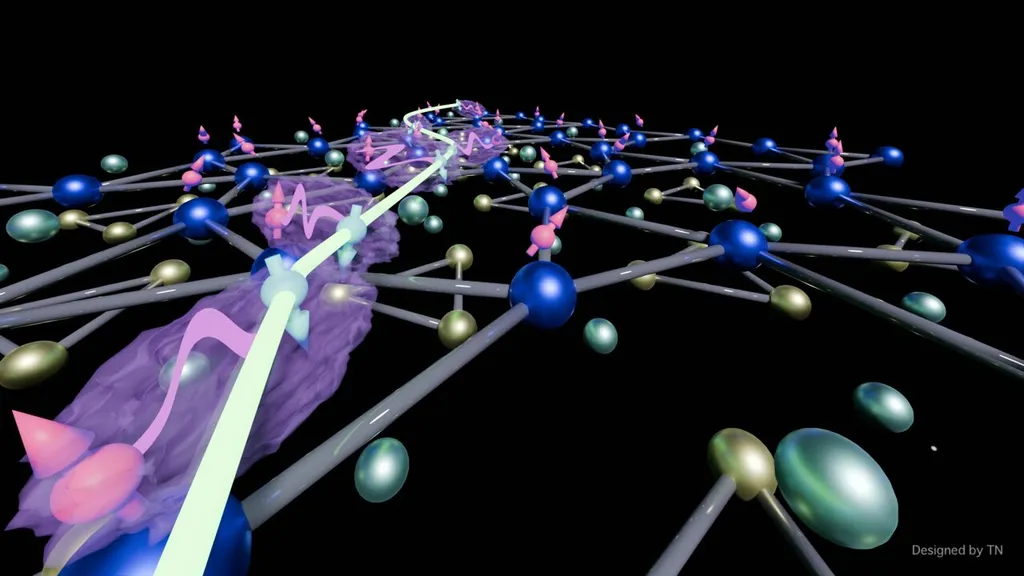
Researchers Gaopei Pan and Fakher F. Assaad from the University of Goettingen have delved into the complex world of heavy fermion systems, using advanced computational techniques to better understand these unique materials. Their work, published in the journal Physical Review B, focuses on a specific aspect of these systems known as Kondo breakdown, which has significant implications for the energy industry, particularly in the development of advanced materials for energy applications.
Heavy fermion systems are a class of materials that exhibit unusual electronic properties, often due to the interaction between localized magnetic moments and conduction electrons. In these systems, the Kondo effect—a phenomenon where magnetic impurities in a metal lose their magnetic moment at low temperatures—plays a crucial role. However, in some cases, this effect can break down, leading to a state known as Kondo breakdown.
Pan and Assaad used a computational method called quantum Monte Carlo simulations to study a spin chain coupled to two-dimensional Dirac conduction electrons. They described the spin chain using a compact U(1) gauge theory, which is a mathematical framework that helps to simplify the description of these complex systems. The heavy-fermion quasiparticle, a key player in these materials, was modeled as a bound state of a U(1) matter field and a fermionic parton.
The researchers identified two distinct regimes in their simulations: a heavy-fermion metal and a Kondo-breakdown metal. In the heavy-fermion metal regime, the system exhibits a sharp composite-fermion resonance and robust low-frequency transport, meaning that electrons can move freely and efficiently. In contrast, the Kondo-breakdown metal regime is characterized by an incoherent resonance and vanishing low-frequency transport, indicating that electron movement is hindered.
The evolution of the composite-fermion spectrum, dynamical spin structure factor, and optical conductivity provided a nonperturbative demonstration of gauge-mediated Kondo breakdown. This means that the breakdown of the Kondo effect is driven by the gauge field, which is a fundamental aspect of the U(1) gauge theory used to describe these systems. The researchers also established transport fingerprints of an orbital-selective Mott transition, which is a type of phase transition that can occur in these materials.
The practical applications of this research for the energy industry are significant. Understanding the behavior of heavy fermion systems and the Kondo effect can help in the development of advanced materials for energy applications, such as more efficient conductors or superconductors. These materials could be used in a variety of energy technologies, from power transmission lines to advanced energy storage systems. By providing a deeper understanding of the underlying physics, this research can guide the development of new materials and technologies that are more efficient, reliable, and sustainable.
In conclusion, Pan and Assaad’s work sheds light on the complex behavior of heavy fermion systems and the Kondo effect. Their findings have important implications for the energy industry, paving the way for the development of advanced materials that could revolutionize energy technologies. As the world continues to seek sustainable and efficient energy solutions, research like this is crucial in driving innovation and progress.
This article is based on research available at arXiv.