
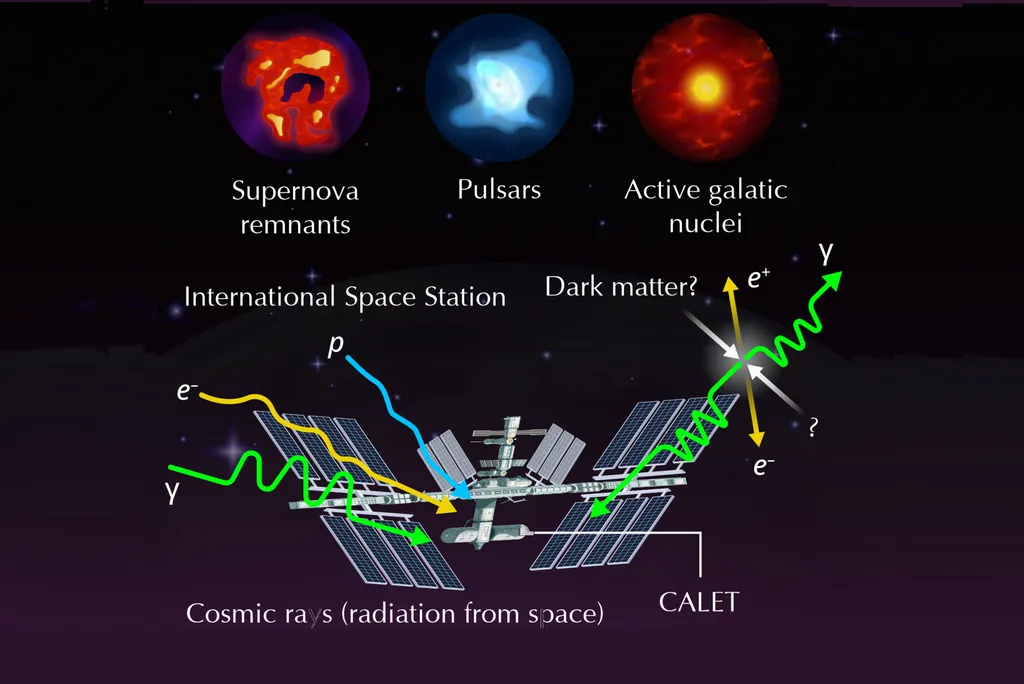
In the realm of high-energy physics and astrophysics, researchers are continually pushing the boundaries of our understanding. Among them is Jiri Kvita, a scientist affiliated with the Institute of Physics of the Czech Academy of Sciences, who has been delving into the mysteries of cosmic rays and the particle showers they initiate in our atmosphere.
Kvita’s recent research focuses on developing a parameterized model of atmospheric particle showers, which are cascades of particles generated when cosmic rays collide with molecules in the Earth’s atmosphere. By tuning a few key physics parameters, Kvita compared his model with the Conex shower generator, a well-established tool in the field. The study, published in the journal Physical Review D, explores the properties of these showers, with particular attention to cases where multiple shower maxima develop.
The research takes an intriguing turn as Kvita introduces simple models of hypothetical new physics resonances with masses of 100 GeV and 1 TeV. These resonances are speculative particles that could potentially exist beyond the Standard Model of particle physics. The study examines how these resonances might affect the shower profile, depth, and maximum variation, depending on their decay channels. The results indicate that the effects of these new resonances could appear at the energy threshold and persist for about a decade in logarithmic energy scale.
Different assumed decay modes of the hypothetical resonance have varying effects on the direction and shape of the modified average shower depth as a function of energy. This has potential implications for current and future measurements in the field. The visibility of the resonance in the modified shower depth is shown to strongly depend on the resonance width, with significant modifications at 10% width diminishing towards the percent-level width.
Kvita proposes that examining the 2D distributions of the two first individual shower moments could also reveal signatures of new physics. This approach could provide additional insights into the nature of cosmic rays and the fundamental particles they produce.
For the energy sector, particularly in the realm of high-energy physics research and particle detection technologies, this research could have practical applications. Understanding the nuances of particle showers and the potential effects of new physics resonances can enhance the accuracy of cosmic ray measurements and improve the design of detectors used in energy-related research. This, in turn, can contribute to advancements in fields such as nuclear energy, astrophysics, and fundamental particle physics.
This article is based on research available at arXiv.