
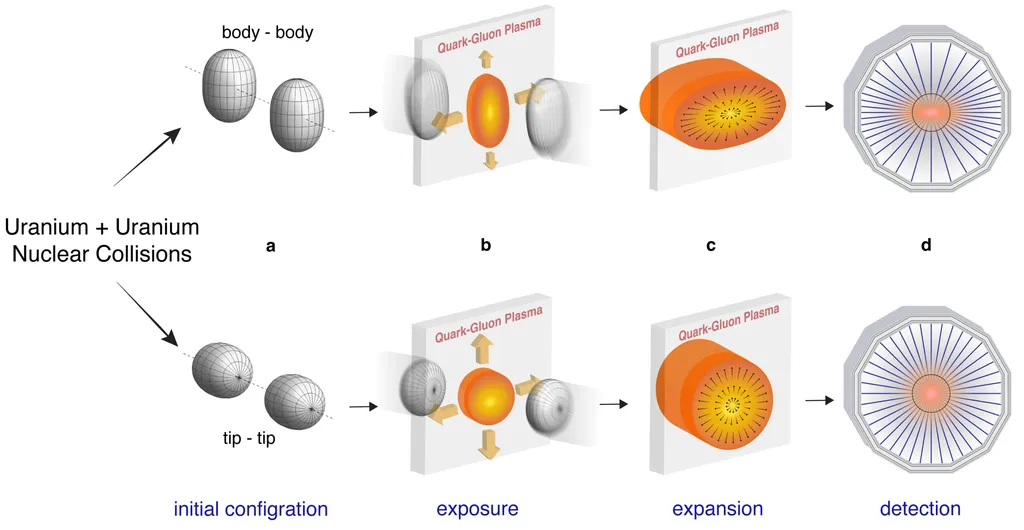
In the realm of high-energy nuclear physics, a team of researchers from Heidelberg University, including Andreas Kirchner, Federica Capellino, Eduardo Grossi, and Stefan Floerchinger, is pushing the boundaries of our understanding of heavy-ion collisions. Their recent work, published in the journal Physical Review C, explores the potential of using fluid dynamics to describe the entire process of a heavy-ion collision, from the initial collision of nuclei to the formation of the quark-gluon plasma phase.
Currently, fluid-dynamical models of nuclear collisions typically begin shortly after the collision itself. This approach introduces significant uncertainties, as the initial state of the collision is not well understood. The researchers propose a novel approach: using a fluid theory of second order to describe the collision process itself, including the state before the collision occurs.
The team’s work focuses on the soft features of the collision, which are less sensitive to the details of the initial state. They argue that these features could be reasonably well described by a fluid-dynamical model, even if the collision involves far-from-equilibrium dynamics. To explore this possibility, they examine the fluid-dynamical equations of motion and study the resulting entropy production.
While this work represents only the first steps in this direction, the researchers outline a larger program of research. Their ultimate goal is to develop a dynamical description of heavy-ion collisions that is based solely on the thermodynamic and transport properties of quantum chromodynamics (QCD), the theory that describes the strong interaction between quarks and gluons.
For the energy sector, this research could have implications for our understanding of the fundamental processes involved in nuclear reactions. A more accurate description of these processes could potentially lead to advances in nuclear energy production, as well as a deeper understanding of the behavior of matter under extreme conditions. However, it is important to note that this research is still in its early stages, and any practical applications are likely to be far in the future.
In the meantime, the work of Kirchner, Capellino, Grossi, and Floerchinger represents an exciting development in the field of high-energy nuclear physics, and a promising avenue for future research. Their findings were published in the journal Physical Review C, under the title “Towards a fluid-dynamical description of an entire heavy-ion collision: from the colliding nuclei to the quark-gluon plasma phase.”
This article is based on research available at arXiv.