
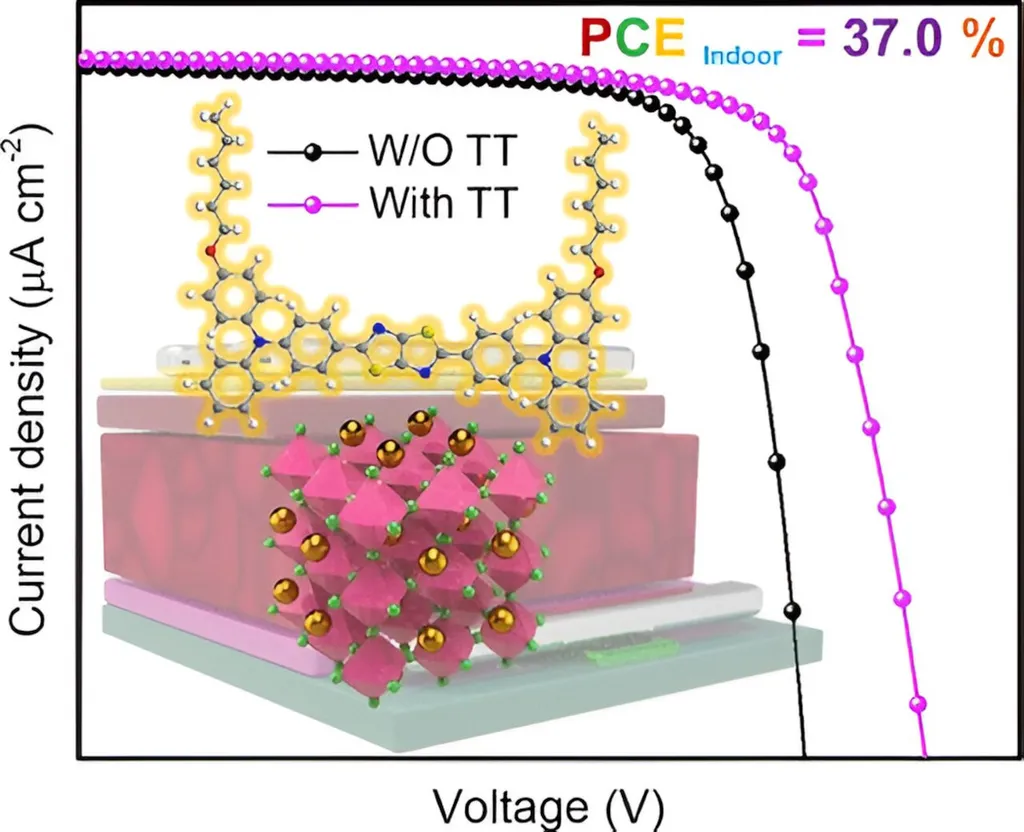
Researchers from King Abdullah University of Science and Technology (KAUST) in Saudi Arabia have published a study in the journal Nature Communications, exploring the potential of perovskite indoor photovoltaics (PIPVs) for efficient energy harvesting under indoor lighting conditions. The team, led by Dr. Miqad S. Albishi and Dr. Abdullah Aljalalah, investigated how adjusting the bandgap of perovskite materials can optimize their performance in low-light environments.
The study focuses on the development of methylammonium-free perovskite absorbers with tailored band gaps of 1.55, 1.72, and 1.88 eV. These band gaps were chosen to better match the spectral response of indoor lighting, which typically has a lower color temperature and intensity than sunlight. The researchers fabricated devices using a scalable mesoscopic n-i-p architecture and evaluated their performance under white LED illumination at various color temperatures (3000-5500 K) and light intensities (250 to 1000 lux).
The results showed that the perovskite composition with a 1.72 eV band gap demonstrated the most consistent performance across different light intensities and color temperatures, achieving power conversion efficiencies (PCEs) of 35.04% at 1000 lux and 36.6% at 250 lux. Additionally, this composition exhibited stable device operation for over 2000 hours. The 1.88 eV band-gap variant reached a peak PCE of 37.4% under 250 lux at 5500 K but showed performance trade-offs under different lighting conditions. In contrast, the 1.55 eV band gap composition underperformed due to suboptimal spectral overlap and utilization.
The researchers also conducted combined experimental and theoretical optical-electrical simulations, suggesting that reducing trap-assisted recombination in wide-bandgap compositions could further improve PIPV performance across various illumination conditions. This study highlights the importance of bandgap optimization and device architecture in developing high-efficiency, stable PIPVs for integration into self-powered electronic systems and innovative indoor environments.
The practical applications of this research for the energy sector include the development of efficient and cost-effective indoor photovoltaic systems for low-light energy harvesting. These systems could be used to power electronic devices in homes, offices, and other indoor settings, reducing the reliance on traditional energy sources and contributing to a more sustainable energy future. The findings also provide valuable insights for researchers and industry professionals working on perovskite solar cells and other photovoltaic technologies.
This article is based on research available at arXiv.