
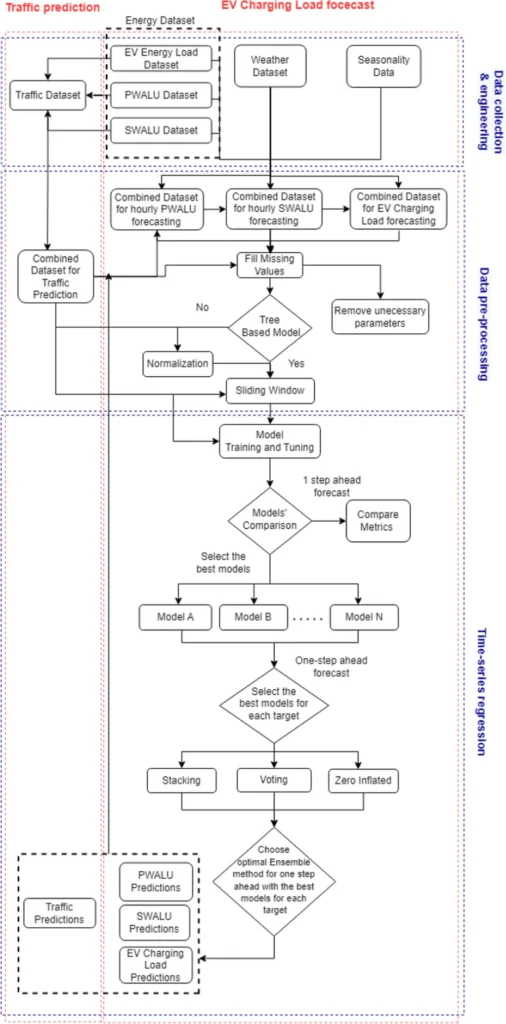
As electric vehicles (EVs) gain traction as a solution to reduce greenhouse gas emissions, the energy sector faces new challenges in managing the electric grid. To address these challenges, researchers Iason Kyriakopoulos and Yannis Theodoridis from the University of Piraeus in Greece have conducted a study to compare various forecasting methods for EV charging demand. Their work, published in the journal Applied Energy, aims to provide insights into the most effective ways to predict EV charging loads across different time frames and spatial scales.
The researchers investigated five time series forecasting models, ranging from traditional statistical approaches to more advanced machine learning and deep learning methods. They evaluated the performance of these models for short-term (minutes), mid-term (hours), and long-term (days) forecasting horizons. Additionally, they assessed the models’ accuracy across different spatial scales, from individual charging stations to regional and city-wide aggregations.
The study utilized four publicly available real-world datasets to ensure the robustness and applicability of the findings. By analyzing these diverse datasets, the researchers could independently evaluate the performance of each forecasting method in various urban settings. This comprehensive approach allows for a more accurate comparison of the models’ effectiveness in predicting EV charging demand.
The findings of this research are crucial for the energy sector, as accurate EV charging load forecasting can help grid operators manage electricity distribution more efficiently. By anticipating demand, operators can optimize the use of renewable energy sources, reduce the need for additional power generation, and minimize the risk of grid congestion. Furthermore, these insights can inform the development of smart charging strategies, such as incentivizing EV owners to charge during off-peak hours, thereby promoting a more sustainable and balanced energy ecosystem.
In summary, Kyriakopoulos and Theodoridis’ study provides a systematic evaluation of EV charging demand forecasting methods, offering valuable insights for the energy industry. By comparing the performance of various models across different temporal horizons and spatial aggregation levels, the researchers have identified the most effective approaches for predicting EV charging loads. These findings can help grid operators and policymakers make informed decisions to support the integration of EVs into the electric grid and promote a more sustainable energy future.
This article is based on research available at arXiv.