
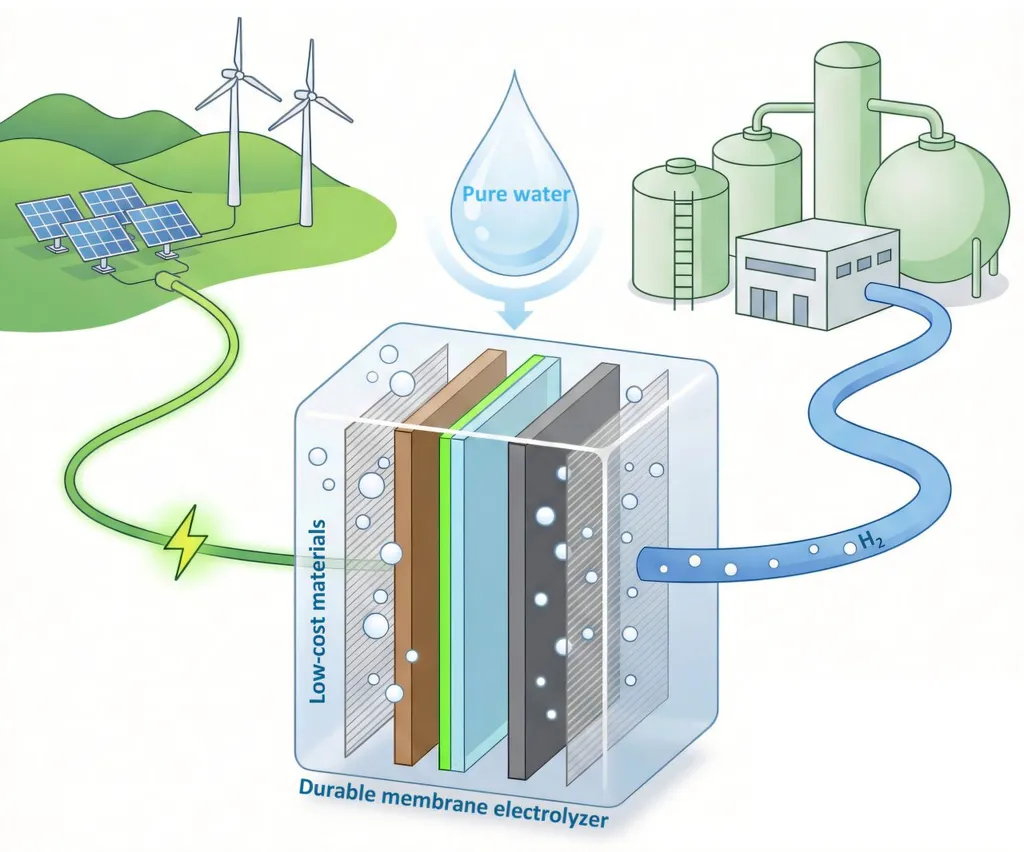
This week, a team of Canadian researchers unveiled a transformative advance in electrolyzer technology, promising to make the conversion of carbon emissions into valuable fuels and chemicals far cheaper and more efficient. Published in Nature Energy, the breakthrough centers on a critical component within electrolyzers—the devices that use electricity to turn CO₂ into usable products. This innovation could remove a longstanding barrier that has stymied the technology for years, offering a tangible path to decarbonizing heavy industry and accelerating the green hydrogen economy.
At the heart of the advance is a novel electrode architecture that dramatically reduces energy losses during electrolysis. Traditional electrolyzers suffer from inefficiencies, often wasting up to 25% of input energy as heat or in parasitic reactions. The Canadian team’s design achieves near-theoretical efficiency, minimizing these losses and enabling the production of hydrogen, syngas, or other chemicals at a fraction of the current cost. “We’re already extending our approach,” said the lead researcher, underscoring the scalability and adaptability of the technology for diverse industrial applications.
The implications are profound. Green hydrogen, produced via electrolysis powered by renewable energy, is seen as a cornerstone of the energy transition, particularly for sectors like steel, shipping, and aviation where direct electrification is challenging. Yet, high capital and operational costs have limited its adoption. This breakthrough could finally make green hydrogen cost-competitive with fossil-derived alternatives, unlocking a wave of investment and deployment. “Cleaner production methods can also improve public health by reducing air pollutants linked to respiratory problems,” noted the research team, highlighting the dual benefits for both climate and community well-being.
Industry watchers are already taking note. The technology’s potential to slash costs and improve efficiency aligns with the urgent need to scale up clean energy solutions. As governments and corporations race to meet net-zero targets, innovations like this could redefine the economics of decarbonization, making ambitious climate goals not just aspirational, but achievable. With breakthroughs such as this new electrolyzer architecture—and an expanding toolkit of ways for everyday people and industries to cut costs and reduce pollution—the future of clean energy looks brighter than ever.