
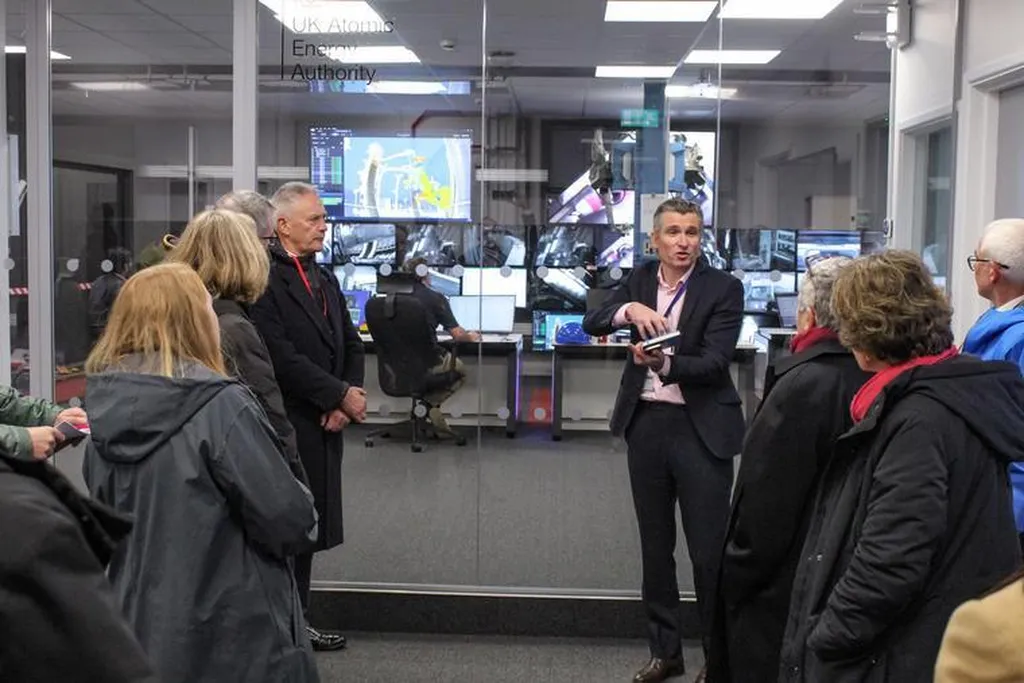
The UK’s nuclear decommissioning sector is experiencing a significant shift, with new collaborations and technical advancements driving progress. The UK Atomic Energy Authority (UKAEA) and the Nuclear Decommissioning Authority (NDA) have formalised their partnership through a Memorandum of Understanding (MOU), aiming to accelerate innovation and efficiency in decommissioning efforts. This collaboration comes at a critical time, as the UK grapples with the legacy of its earliest nuclear sites and prepares for future fusion power.
Clive Nixon, NDA Group Chief Nuclear Strategy Officer, emphasised the importance of this partnership: “The NDA group are at the forefront of nuclear decommissioning. We have one of the most experienced and skilled nuclear workforces in the world, developing pioneering solutions which have applications across the nuclear sector and beyond.” The NDA oversees the clean-up of 17 nuclear sites, one of Europe’s most extensive decommissioning efforts. By working closely with UKAEA, the NDA aims to share and benefit from lessons learned across both fission and fusion programmes, ultimately reducing costs and improving long-term outcomes.
A key focus of this collaboration is the decommissioning of the Joint European Torus (JET), a world-leading fusion research facility operated by UKAEA. As JET transitions from plasma operations to shutdown and repurposing, it is drawing on NDA expertise to embed proven approaches early in the planning process. JET’s Decommissioning and Repurposing (JDR) team has already benefited from NDA advice on waste treatment routes, regulatory compliance, and processing infrastructure. This exchange of knowledge is expected to accelerate efficiency gains and set a benchmark for future fusion facilities.
The partnership is not a one-way exchange. Technologies and techniques developed for JET’s unique fusion environment could be adapted for use across the NDA estate. Both organisations already collaborate through RAICo, the Robotics and Artificial Intelligence Collaboration, highlighting how digital tools and automation can transform nuclear decommissioning. This cross-sector approach reflects the shared challenges faced by fusion and fission programmes, including hazardous waste management, remote handling, and long-term site remediation.
Alongside the new partnership, the NDA group has achieved a significant nuclear safety milestone at its Sellafield site. For the first time, a can of plutonium residue has been safely processed into a stable waste form, marking a crucial step toward permanently addressing the UK’s plutonium legacy. This breakthrough initiates a programme to treat around 400 cans of plutonium residue, a by-product of historic fuel and materials manufacturing. The processing is taking place in a facility that has operated safely since the mid-1980s, demonstrating how repurposing existing infrastructure can deliver faster results.
Building on this success, the NDA group now faces its biggest task yet: immobilising the UK’s entire civil separated plutonium inventory. Commissioned by the government in January 2025, this programme aims to permanently secure plutonium by locking it into a stable form for disposal in a future Geological Disposal Facility. Backed by £154m of government funding over five years, the work will support around 100 jobs, mostly in Cumbria.
David Peattie, NDA Group CEO, highlighted the significance of this milestone: “This UK-first milestone demonstrates the unrivalled expertise of the NDA group, with special recognition for the Sellafield team whose innovation and specialist skills have made this achievement possible.” The full immobilisation programme will take many decades, but processing the first can of residue into a disposable form represents significant progress and was achieved within 12 months of the policy being announced.
This news shapes the development of the sector by fostering a more integrated approach to nuclear decommissioning. The collaboration between UKAEA and NDA not only accelerates progress in decommissioning legacy sites but also lays the groundwork for future fusion power. The exchange of knowledge and technology between fission and fusion programmes highlights the interconnectedness of these fields and the potential for shared solutions. Additionally, the successful processing of plutonium residue at Sellafield demonstrates the value of repurposing existing infrastructure and the importance of government investment in long-term nuclear safety initiatives. As the UK continues to address its nuclear legacy, these developments will be crucial in ensuring the safe and efficient management of nuclear waste and the advancement of fusion energy.