
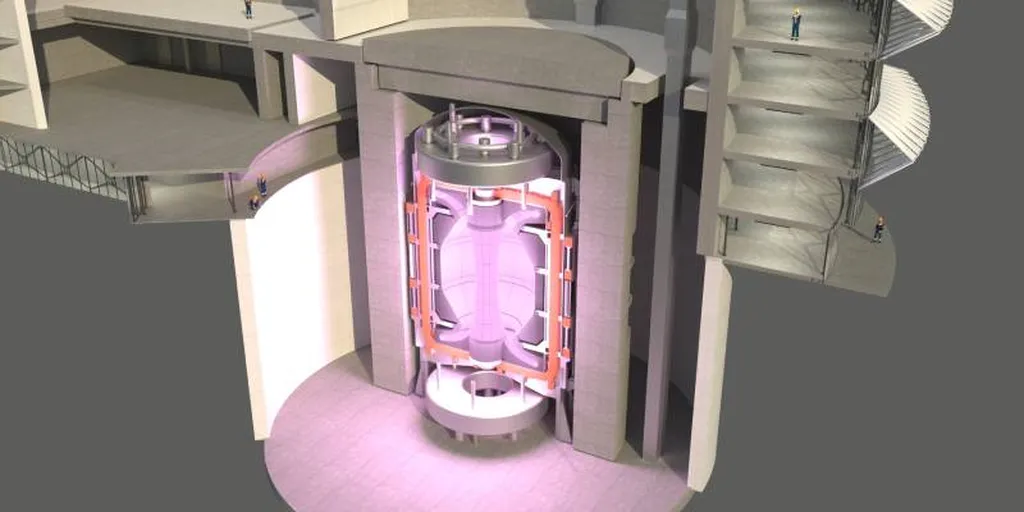
In the realm of energy research, two scientists from the University of York, Nathan Welch and Chris Marsden, have developed a novel approach to optimize the design of superconducting coils for tokamak fusion devices. Their work, published in the journal Fusion Engineering and Design, aims to streamline the complex process of designing these crucial components, which are integral to the operation of fusion reactors.
Designing superconducting coils for tokamak fusion devices is a complex task that involves balancing numerous engineering requirements and constraints. These coils must be capable of containing plasma scenarios at various stages, from inception to ramp down, while applying a controlled inductive voltage to drive current. Additionally, the design must consider the physical limits of the tokamak, including space for support structures and maintenance access.
Welch and Marsden’s method, dubbed SCOPE (Simple Coil Optimization for Plasma and Engineering), employs a combined simulated annealing technique to find optimal coil sizes and positions. This approach uses a constrained quadratic or quartic optimization for the coil currents, allowing for the simultaneous optimization of coils for multiple scenarios. The method is designed to prevent over-optimization for a single design point, ensuring a more robust and versatile coil design.
One of the key advantages of the SCOPE method is its efficiency. The researchers have implemented the method in a way that allows millions of evaluations to be performed in just a few hours using modest computational power. This efficiency is crucial for the iterative design process, enabling further detailed design work to feed back into the optimization.
The practical applications of this research for the energy sector are significant. By optimizing the design of superconducting coils, the SCOPE method can contribute to the development of more efficient and effective fusion reactors. This, in turn, can help advance the commercialization of fusion energy, a clean and virtually limitless energy source. The method is part of a larger, iterative workflow that facilitates further detailed design work, making it a valuable tool for engineers and researchers in the field.
In summary, Welch and Marsden’s research presents a novel and efficient approach to optimizing the design of superconducting coils for tokamak fusion devices. Their work, published in Fusion Engineering and Design, offers practical benefits for the energy sector, particularly in the development of fusion reactors. By streamlining the design process and enabling more robust coil designs, the SCOPE method can contribute to the advancement of fusion energy as a viable and sustainable energy source.
This article is based on research available at arXiv.