
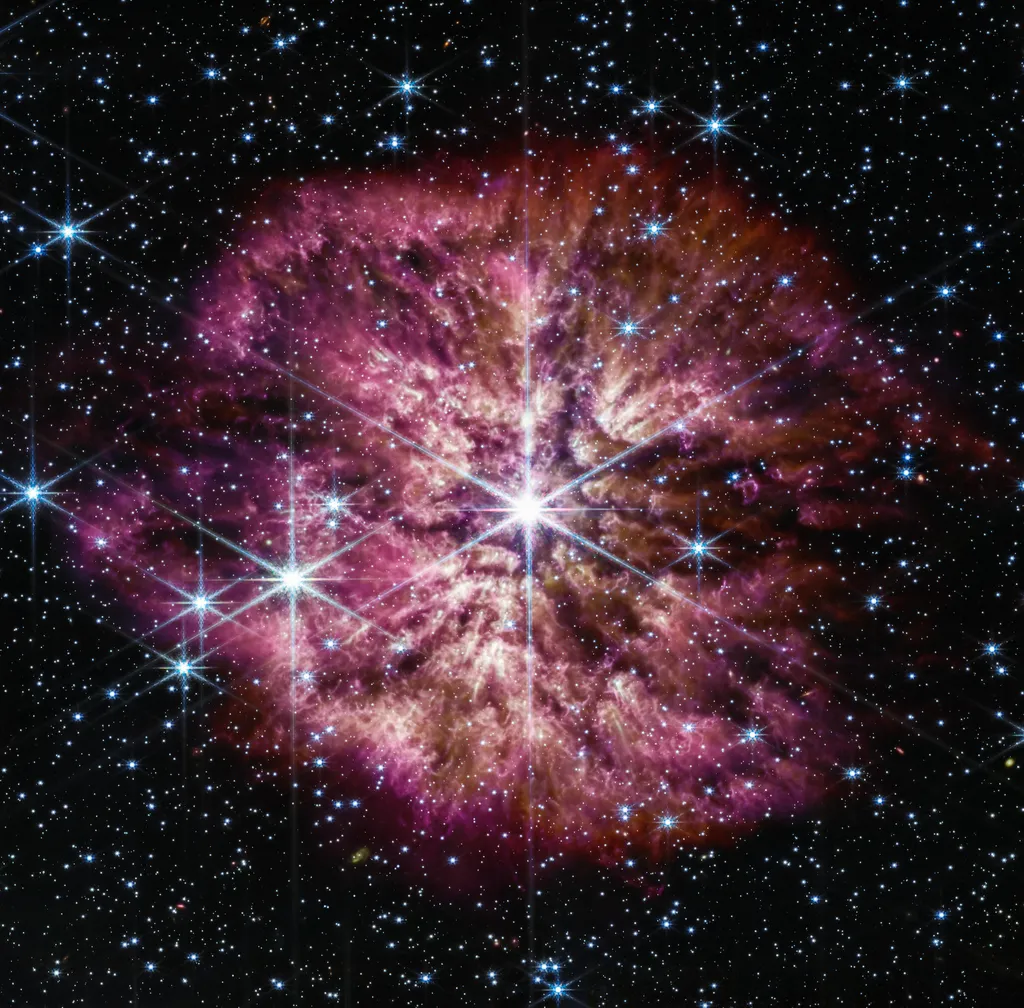
Researchers Yotam Cohen, Ealeal Bear, and Noam Soker from the Technion-Israel Institute of Technology have published a study that explores the behavior of evolved massive stars, like Wolf-Rayet (WR) stars, during high-rate mass accretion. Their findings, published in the journal Monthly Notices of the Royal Astronomical Society, could have implications for understanding certain astronomical events and potentially even energy generation processes.
The team used one-dimensional stellar evolution models with MESA to simulate the accretion process onto a stripped-envelope star. They focused on a scenario where mass is added to the star via an accretion disk, which then launches jets that remove the outer layers of the star’s inflated envelope. This process, termed the ‘jetted mass removal accretion scenario,’ was mimicked by dividing the accretion period into hundreds of pulses. In each pulse, mass was added in the first half and then a fraction of this mass was removed in the second half.
The researchers found that removing tens of percent of the added mass significantly decreased the stellar expansion. This means that WR stars can maintain a deep gravitational potential well and not expand much while accreting mass at high rates. This is crucial because it allows for the formation of an accretion disk and the liberation of large amounts of gravitational energy.
The practical applications of this research for the energy sector are not direct, but the understanding of mass accretion and energy liberation processes in stars can contribute to broader astrophysical models. These models can, in turn, inform our understanding of energy generation and transfer in the universe. Additionally, the study strengthens models of intermediate-luminosity optical transients, such as luminous red novae, where a non-degenerate star accretes at high rates and launches jets that power the transient event. This could help in developing better predictive models for such astronomical phenomena.
In summary, the research provides valuable insights into the behavior of massive stars during high-rate mass accretion, contributing to our understanding of stellar evolution and energy processes in the universe. The findings could indirectly support advancements in energy research by enhancing our knowledge of fundamental astrophysical processes.
This article is based on research available at arXiv.