
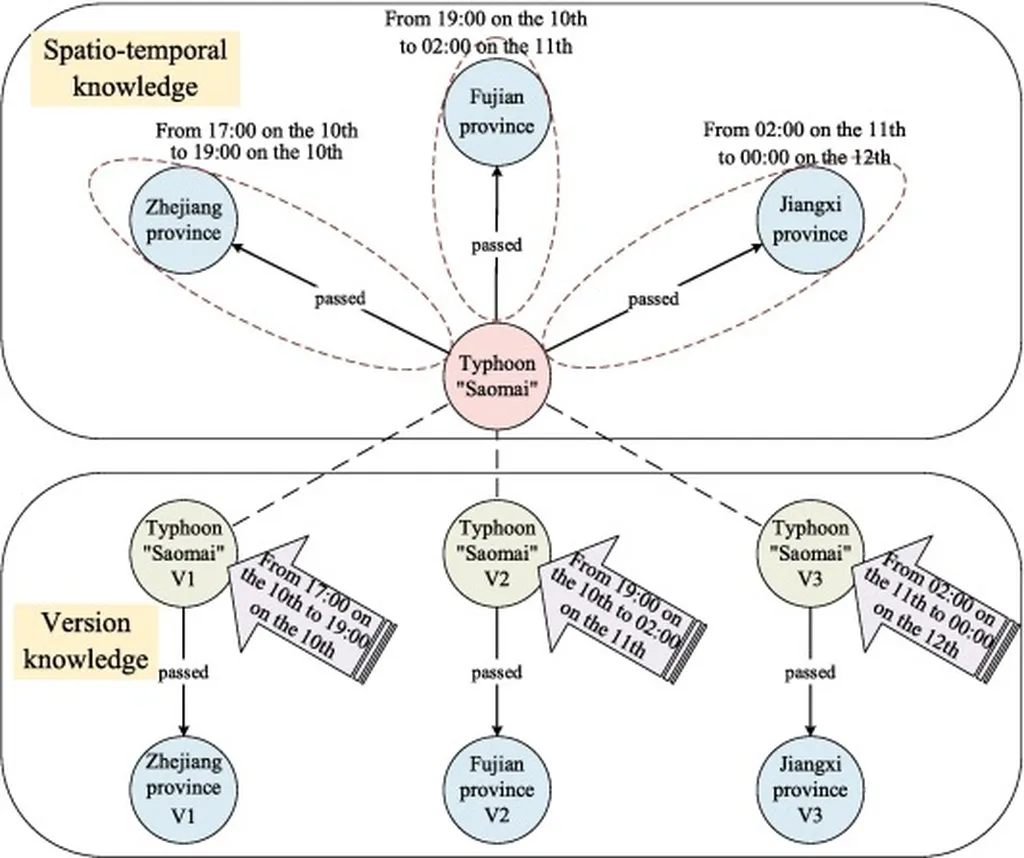
Researchers Philipp Plamper, Hanna Köpcke, and Anika Groß from the University of Potsdam have conducted a comprehensive survey on spatio-temporal knowledge graphs (STKGs), a topic of growing interest in various domains, including energy and environmental systems. Their work was recently published in the journal “ACM Computing Surveys.”
Spatio-temporal knowledge graphs are a powerful tool for representing and analyzing complex systems that have both temporal and spatial characteristics. They integrate entities, relationships, time, and space within a unified graph structure. This makes them particularly useful for modeling and understanding systems like environmental networks, urban infrastructure, transportation systems, and social mobility patterns.
However, the researchers point out that modeling STKGs is not straightforward. The field draws from classical graph theory as well as temporal and spatial graph models, which have evolved independently and use different terminologies and assumptions. This lack of conceptual alignment has led to a proliferation of approaches that are often tailored to specific use cases rather than designed for reuse or long-term knowledge preservation.
The survey provides a systematic review of existing STKG models, tracing their origins and analyzing them along key dimensions such as edge semantics, temporal and spatial annotation strategies, and temporal and spatial semantics. The researchers relate these modeling choices to their respective application domains, highlighting the need for more unified and generalizable frameworks.
For the energy sector, STKGs could have practical applications in areas like smart grid management, where understanding the spatial and temporal dynamics of energy consumption and distribution is crucial. They could also be used to model and analyze the impact of renewable energy sources, which are inherently variable and dependent on both time and location.
The researchers conclude by deriving modeling guidelines and identifying open challenges to guide future research. They emphasize the need for more standardized and reusable models that can support long-term knowledge preservation and facilitate collaboration across different domains.
In summary, while STKGs hold great promise for modeling complex systems in the energy sector and beyond, there is still much work to be done to develop more unified and generalizable approaches. The survey by Plamper, Köpcke, and Groß provides a valuable roadmap for future research in this exciting and rapidly evolving field.
This article is based on research available at arXiv.