
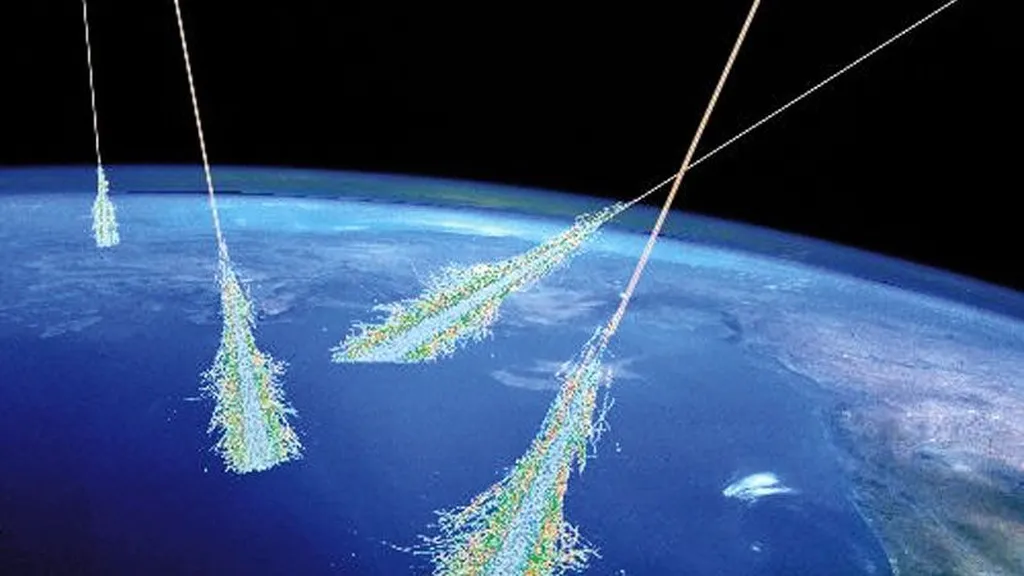
In a recent study, researchers from the University of Lyon, including Olivier Le Noan, Emmanuelle Khan, Samuel Goriley, and Konrad Sieja, have delved into the complex world of ultra-high-energy cosmic rays (UHECR) and their interaction with light nuclei. Their work, published in the journal Physical Review C, aims to enhance our understanding of UHECR propagation, which has implications for both astrophysics and nuclear energy applications.
Ultra-high-energy cosmic rays are particles of extragalactic origin that travel vast distances before reaching Earth. As they journey through space, they interact with the cosmic background radiation, a process dominated by photoabsorption at energies corresponding to the Giant Dipole Resonance (GDR) region. To accurately model these interactions, researchers need a comprehensive understanding of the photoabsorption cross sections of light nuclei and their subsequent particle decay.
The researchers employed the Configuration Interaction Shell Model (CI-SM) approach to predict the electric dipole (E1) response for light nuclei with mass numbers between 7 and 40. The E1 response, characterized by the photon strength function (PSF), is a crucial ingredient in various nuclear structure applications, including nuclear reactor design and nuclear waste transmutation. The study compared theoretical predictions with available data and existing models, providing a robust validation of the CI-SM approach.
One of the practical applications of this research is in the modeling of UHECR propagation. The study investigated the impact of using CI-SM PSF on the predicted propagation of a calcium-40 (40Ca) UHECR source. Accurate modeling of UHECR propagation is essential for understanding the origins and nature of these high-energy particles, which can provide insights into the most energetic processes in the universe.
For the energy sector, a better understanding of nuclear reactions and photoabsorption cross sections can lead to improvements in nuclear reactor design and safety. It can also aid in the development of advanced nuclear waste transmutation technologies, which are crucial for managing radioactive waste and reducing the environmental impact of nuclear energy.
In summary, the research conducted by Le Noan and colleagues provides valuable theoretical predictions of the E1 dipole response for light nuclei, enhancing our ability to model UHECR propagation. This work not only advances our understanding of astrophysical phenomena but also has practical applications in the energy sector, particularly in nuclear reactor design and waste management.
This article is based on research available at arXiv.