
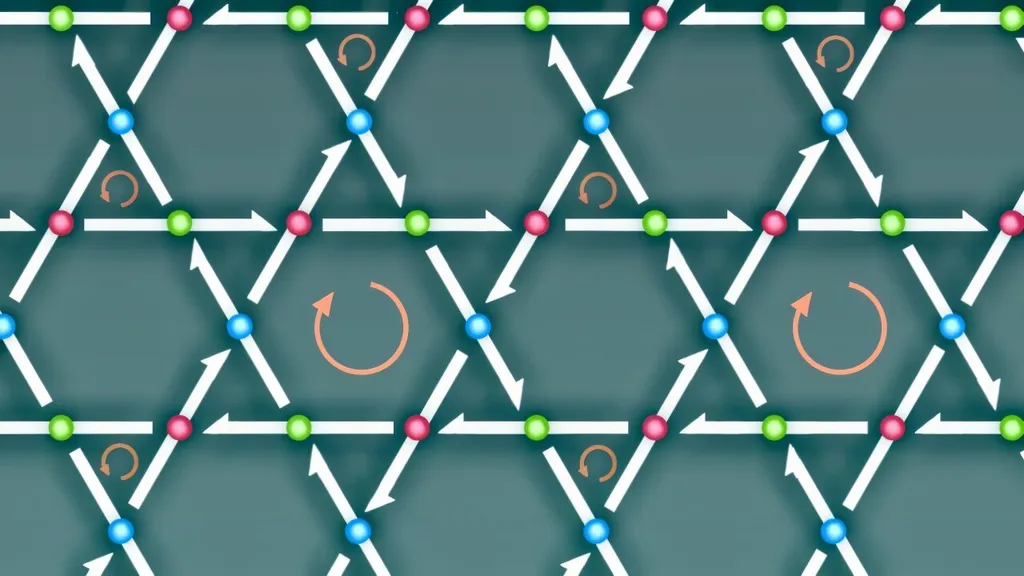
In the realm of energy materials research, a team of scientists from the University of Central Florida, led by Jhinkyu Choi, has uncovered intriguing thermal transport properties in a unique material called TbCr6Ge6. This compound, a type of kagome metal, has shown unusual behavior in how it conducts heat and electricity, which could have implications for the energy industry’s pursuit of more efficient materials.
The researchers explored the thermal Hall effect and the Wiedemann-Franz (WF) law in this material. The thermal Hall effect is a phenomenon where a temperature gradient in a material, in the presence of a magnetic field, can generate a transverse heat current. The WF law, on the other hand, is a fundamental principle that relates the thermal and electrical conductivities of a material. The team observed a significant deviation from the WF law in TbCr6Ge6, particularly around its ferrimagnetic transition temperature. This deviation suggests that heat and charge transport in this material are not as closely coupled as previously thought.
The researchers found that both the longitudinal and transverse Lorenz ratios, which are measures of the relationship between thermal and electrical conductivities, deviate strongly from the expected value near the ferrimagnetic transition. After a partial recovery, these ratios are sharply suppressed at lower temperatures, indicating a decoupling between heat and charge transport. This behavior points to the presence of charge-neutral excitations that contribute to heat transport but not to electrical conduction. These findings were published in the journal Nature Communications.
The practical applications of this research for the energy sector could be significant. Understanding and controlling thermal transport in materials is crucial for developing more efficient energy technologies. For instance, materials that can effectively manage heat can improve the performance of power generation and storage systems. The unique properties of TbCr6Ge6 could inspire the development of new materials with tailored thermal transport characteristics, potentially leading to advancements in energy conversion and management technologies. However, it’s important to note that this research is in its early stages, and further work is needed to fully understand and harness these effects for practical applications.
This article is based on research available at arXiv.