
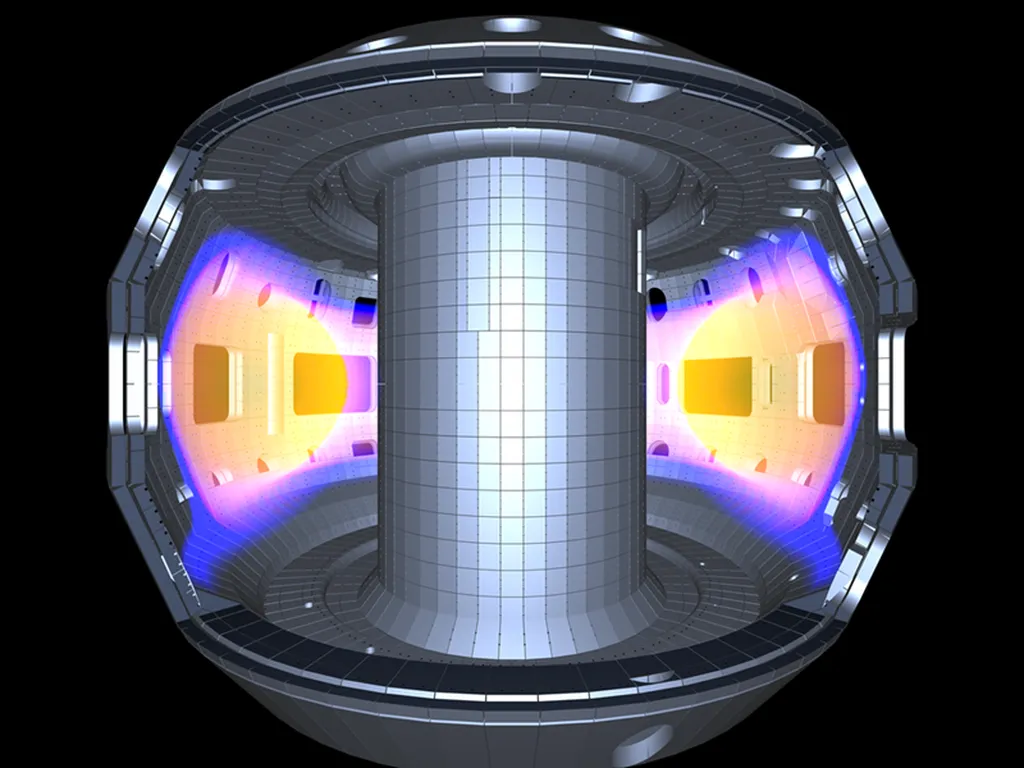
In the realm of fusion energy, a team of researchers from Tokamak Energy Ltd., led by M. Scarpari and X. Zhang, has been working on a critical aspect of tokamak design: managing plasma disruptions. Their recent study, published in the journal Nuclear Fusion, focuses on the pre-conceptual design of the ST-E1, a compact, low aspect-ratio tokamak fusion power plant.
Plasma disruptions pose a significant challenge to tokamak operations, as they can damage the machine and reduce its availability. While strategies to minimize disruptions are essential for future fusion devices, complete avoidance is not feasible. Therefore, understanding and characterizing the consequences of unmitigated disruptions is crucial for designing and qualifying next-generation fusion power plants.
The researchers presented a comprehensive disruption modelling approach applied across different design stages of the ST-E1. This methodology integrates both physics and engineering considerations to evaluate the impact of disruptions on machine performance and structural integrity. From an engineering perspective, the team analyzed several ST-E1 layout options to investigate the electromagnetic response of key components under disruption-induced loads. This analysis enabled comparisons between alternative design solutions.
On the physics side, the study explored a broad set of disruption scenarios, scanning operational space parameters, plasma-material interactions, and associated thermal loads. The researchers also examined variations in disruption behavior arising from different reference equilibria, focusing on configurations ranging from Double Null to Single Null. These configurations reflect the increasing up-down asymmetry consequences, revealing significant contrasts in plasma dynamics and structural electromagnetic behavior.
The results highlight the importance of disruption modelling in guiding design choices. These analyses have proven instrumental in shaping the ST-E1 development, offering critical insights for mitigating risks and optimizing future fusion reactor designs. The practical applications of this research extend to the broader energy sector, particularly in advancing the design and safety of fusion power plants, which could potentially provide a clean, abundant, and sustainable energy source.
The research was published in the journal Nuclear Fusion, a leading publication in the field of plasma physics and fusion energy research. This study underscores the ongoing efforts to overcome the technical challenges in fusion energy, bringing us closer to realizing its potential as a viable and transformative energy solution.
This article is based on research available at arXiv.