
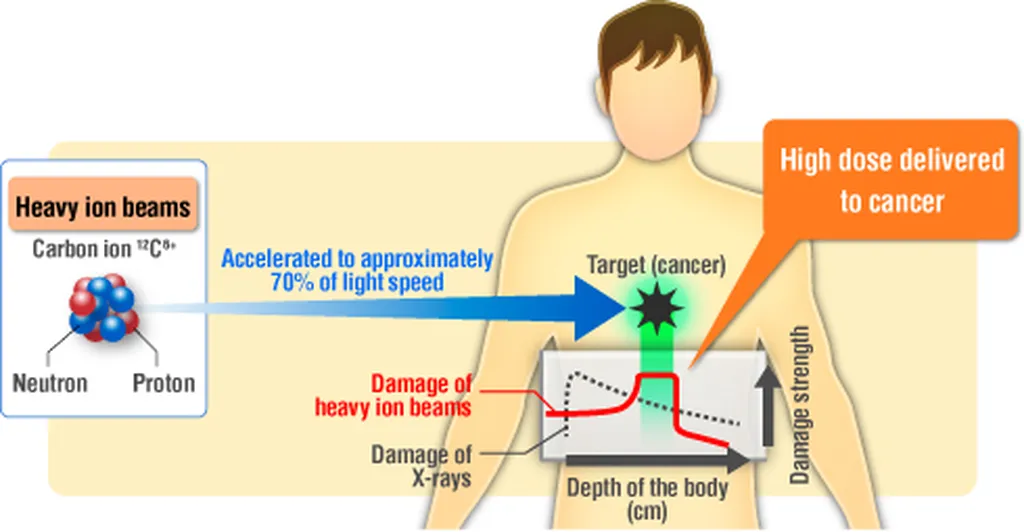
In the realm of cancer treatment, a team of researchers from the Technical University of Darmstadt, Germany, led by Jeannette Jansen, is revisiting the potential of very heavy ions for precision radiotherapy. The team, which includes Olga Sokol, Yolanda Prezado, and Marco Durante, is exploring the use of neon ions to target resistant, hypoxic tumors, a type of cancer that is particularly difficult to treat due to its low oxygen levels and resistance to radiation.
Over half a century ago, the Lawrence Berkeley Laboratory initiated clinical trials using particles ranging from helium to argon for cancer treatment. However, the trials found that ions with an atomic number greater than 10 were highly toxic to normal tissues, leading to a shift towards using helium ions, which have biological effects similar to protons. Fast forward to today, and advancements in radiotherapy strategies have emerged, offering the potential to reduce normal tissue toxicity while maintaining tumor control. This has sparked a renewed interest in the clinical use of heavier ions.
The researchers propose that neon ions could be an effective modality for treating resistant, hypoxic tumors. Neon ions are expected to exhibit high relative biological effectiveness and a low oxygen enhancement ratio, making them potentially ideal for targeting these challenging tumors. However, the associated toxicity of neon ions is a concern. To mitigate this, the researchers suggest employing novel strategies such as ultra-high dose rate (FLASH) radiotherapy or spatially fractionated radiotherapy.
FLASH radiotherapy involves delivering radiation at an extremely high dose rate, which has been shown to reduce damage to healthy tissues while maintaining the same level of tumor control. Spatially fractionated radiotherapy, on the other hand, involves delivering radiation in a grid pattern, creating small areas of healthy tissue within the irradiated volume. This approach has also been shown to reduce toxicity to normal tissues.
The researchers are currently planning and discussing the prospects for the clinical application of neon ions. Their work, published in the journal Physics in Medicine & Biology, offers a promising avenue for the energy sector’s application in the medical field, particularly in the development of advanced radiotherapy techniques for cancer treatment. As the energy industry continues to innovate, the potential for heavy ions in precision radiotherapy could open up new possibilities for targeted, effective cancer treatments.
This article is based on research available at arXiv.