
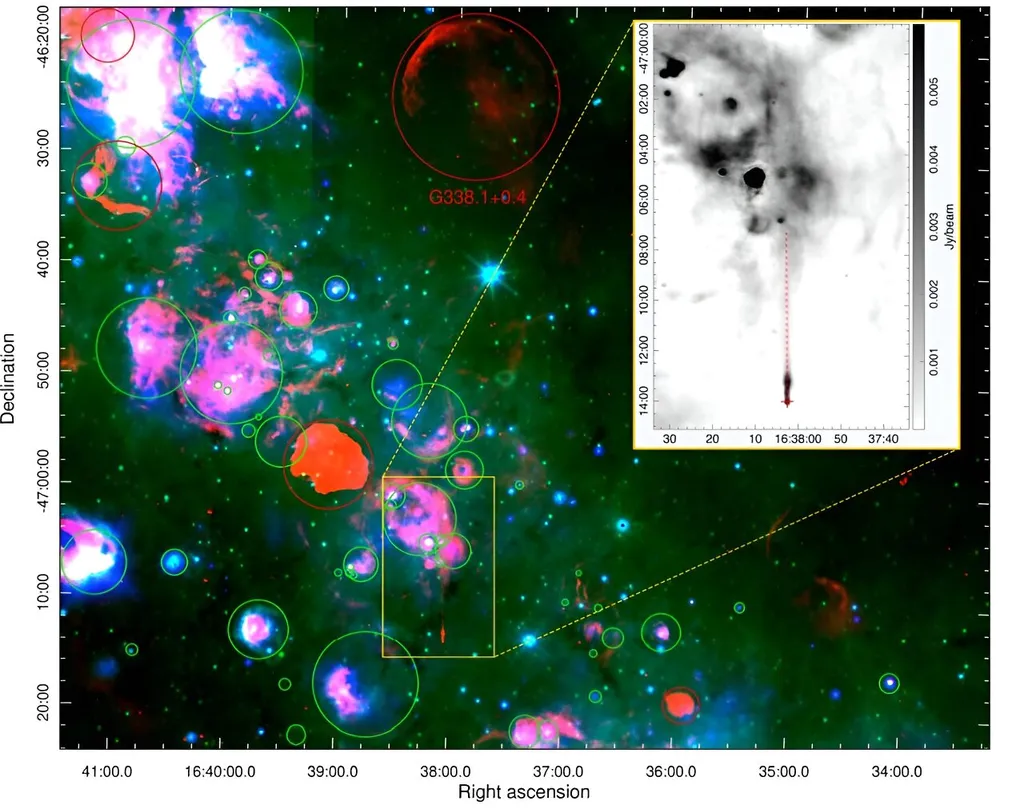
In the realm of astrophysics and energy research, understanding the behavior of particles in space can have profound implications for our understanding of energy processes in the universe. Researchers Luca Orusa and Lorenzo Sironi, affiliated with Columbia University, have delved into the intriguing phenomenon of pulsar wind nebulae (PWNe) and the formation of X-ray filaments. Their findings, published in the journal Physical Review Letters, shed light on the self-confinement of relativistic pair beams in magnetized interstellar plasmas.
Pulsar wind nebulae are regions of space where energetic particles, primarily electrons and positrons, stream out from pulsars—rapidly rotating neutron stars. These particles interact with the interstellar medium, creating complex structures such as filamentary X-ray emissions. Observations of these structures near bow-shock PWNe, like the Guitar, Lighthouse, and PSR J2030+4415 nebulae, have challenged the standard models of cosmic-ray transport. Specifically, the diffusion of these particles appears to be significantly slower than the Galactic average, suggesting the presence of self-generated magnetic turbulence.
Orusa and Sironi’s research focuses on the mechanisms behind this suppressed diffusion. They propose that the non-resonant streaming instability, driven by the escaping electron-positron pairs, plays a crucial role. This instability requires a net current, but the pair beam is expected to be charge-neutral. Through advanced particle-in-cell simulations, the researchers demonstrate that a charge-neutral pair beam can spontaneously generate a net current as it propagates through an electron-proton plasma.
The simulations reveal that beam electrons become focused into self-generated magnetic filaments, a result of the nonlinear evolution of the Weibel instability. In contrast, beam positrons remain unconfined. This asymmetry creates a net positron current, which drives the non-resonant streaming instability, further amplifying the magnetic field. This mechanism not only explains the formation of X-ray filaments but also has broader implications for particle self-confinement in TeV halos around PWNe.
For the energy sector, understanding these processes can provide insights into the behavior of high-energy particles in space, which is relevant for space-based energy systems and the study of cosmic radiation. The research highlights the importance of magnetic fields in controlling the transport of energetic particles, a factor that could influence the design of future space-based energy technologies. By unraveling the complexities of these astrophysical phenomena, scientists can pave the way for innovative applications in energy research and technology.
This article is based on research available at arXiv.