
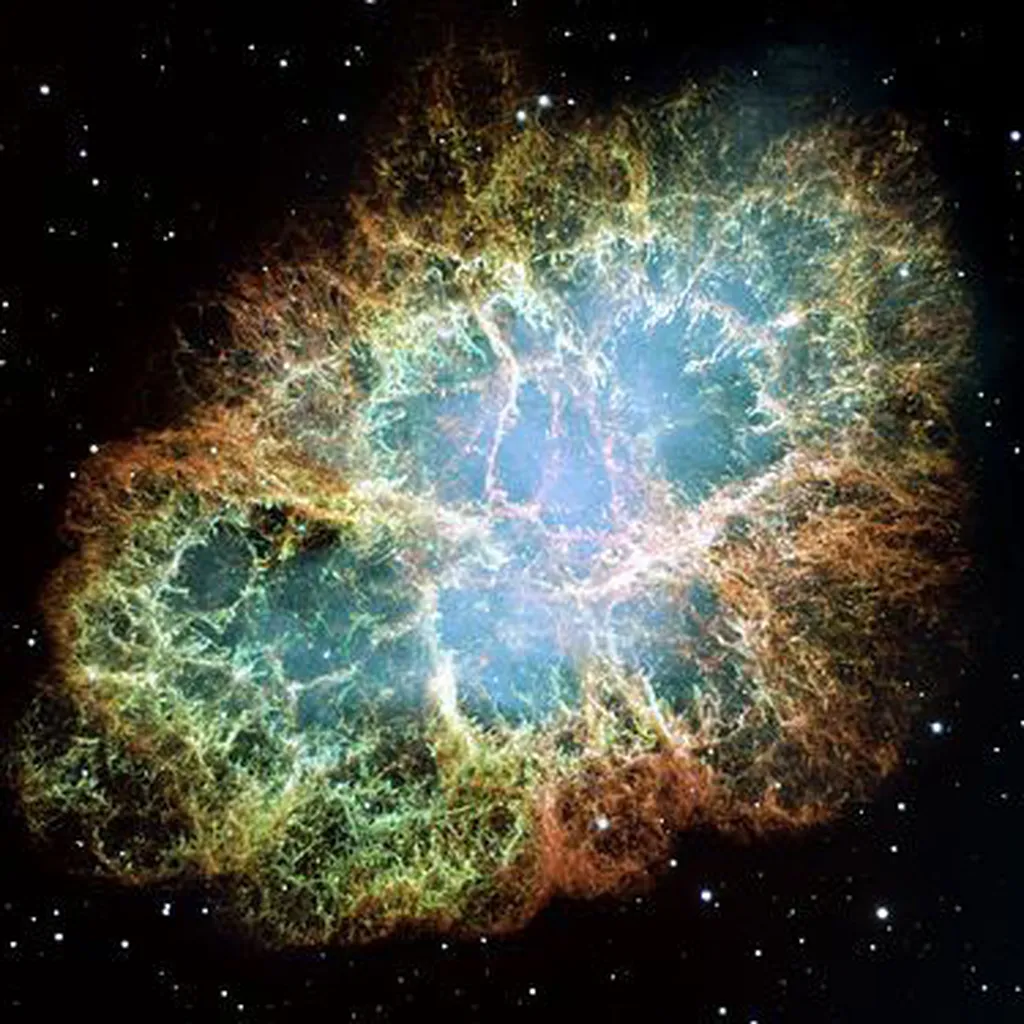
In the realm of astrophysics, a team of researchers led by Joseph D. Gelfand from the University of Toronto, along with colleagues from various institutions including the University of Manchester, the National Astronomical Observatories of China, and the Netherlands Institute for Radio Astronomy, are delving into the mysteries of pulsar wind nebulae (PWNe). These phenomena, born from the interaction between a pulsar’s wind and its surroundings, offer crucial insights into the physics of neutron star magnetospheres and the behavior of ultra-relativistic particles.
Pulsar wind nebulae are regions where the wind from a pulsar—powered by the rotational energy of a neutron star—interacts with the interstellar medium. Studying these nebulae, particularly their radio emissions, can reveal how electron-positron pairs are produced in the magnetospheres of neutron stars and how these particles are accelerated to extremely high energies, up to 10^15 electron volts. Understanding these processes is vital for comprehending the origin of some of the highest energy particles produced within our galaxy.
The researchers highlight the potential of the Square Kilometer Array (SKA), a next-generation radio telescope, to significantly advance our knowledge in this field. The SKA’s enhanced sensitivity, dynamic range, and timing capabilities promise to provide spatially-resolved studies of the continuum and polarized radio emission from PWNe. This could lead to breakthroughs in understanding the acceleration and propagation of particles within these nebulae and the surrounding interstellar medium.
The practical applications for the energy sector, while not immediately obvious, lie in the broader implications of understanding high-energy particle acceleration. Insights gained from studying PWNe could contribute to the development of advanced particle acceleration technologies, which have potential applications in various energy-related fields, including nuclear fusion research and the development of more efficient particle accelerators for industrial and medical use.
This research was published in the journal Experimental Astronomy, underscoring the interdisciplinary nature of the study and its potential to bridge the gap between astrophysics and energy technology. As the SKA comes online, the team’s work is expected to pave the way for new discoveries that could have far-reaching implications for both fundamental physics and applied energy research.
This article is based on research available at arXiv.