
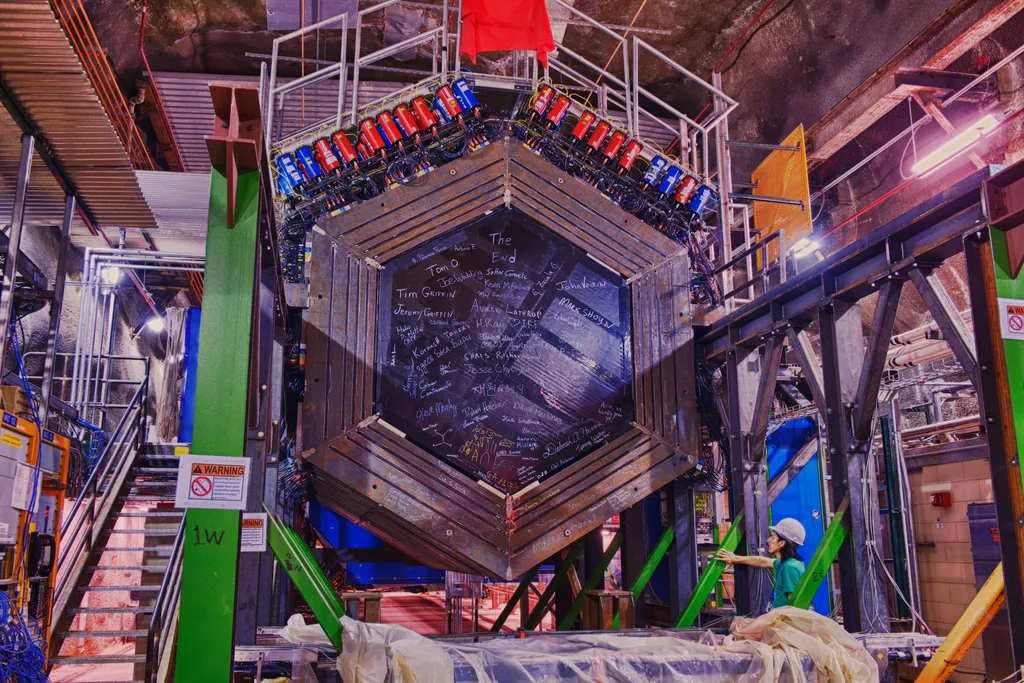
Researchers from the MINERvA collaboration, a group of scientists from various institutions including the University of Rochester, the University of Pittsburgh, and the University of Manchester, have published a study in the journal Physical Review D that delves into the intricacies of neutrino-nucleon interactions, specifically focusing on the nucleon axial form factor, a critical component in predicting neutrino event rates in long-baseline neutrino oscillation experiments.
Neutrino interactions with matter are pivotal in understanding fundamental physics and have practical implications for the energy sector, particularly in the development of next-generation nuclear reactors and the study of nuclear waste transmutation. One common type of neutrino interaction is quasielastic scattering, where a neutrino interacts with a nucleon (a proton or neutron) in a nucleus, resulting in a low reaction threshold and most of the energy being carried by two final state particles. The nucleon axial form factor, denoted as FA(Q²), is a dominant source of uncertainty in predicting the rates of these events.
The researchers examined constraints on the nucleon axial form factor that can be achieved from datasets of neutrino scattering on deuterium targets, predictions from Lattice QCD (Quantum Chromodynamics), and recent hydrogen target data from the MINERvA Collaboration. They found significant tension between the data obtained from hydrogen and deuterium targets, suggesting that extractions from deuterium may underestimate both the central value and uncertainty of the form factor.
This study provides improved parameterizations for and uncertainties of the nucleon axial form factor using the z expansion, a mathematical technique used to represent complex functions. The findings are crucial for enhancing the precision of neutrino event rate predictions, which in turn can aid in the development of more accurate models for neutrino interactions in both experimental and applied settings within the energy industry.
The research was published in Physical Review D, a peer-reviewed scientific journal that covers topics in particle physics, field theory, gravitation, and cosmology. The improved understanding of neutrino-nucleon interactions can have practical applications in the energy sector, particularly in the design and optimization of nuclear reactors and the study of nuclear waste transmutation processes.
This article is based on research available at arXiv.