
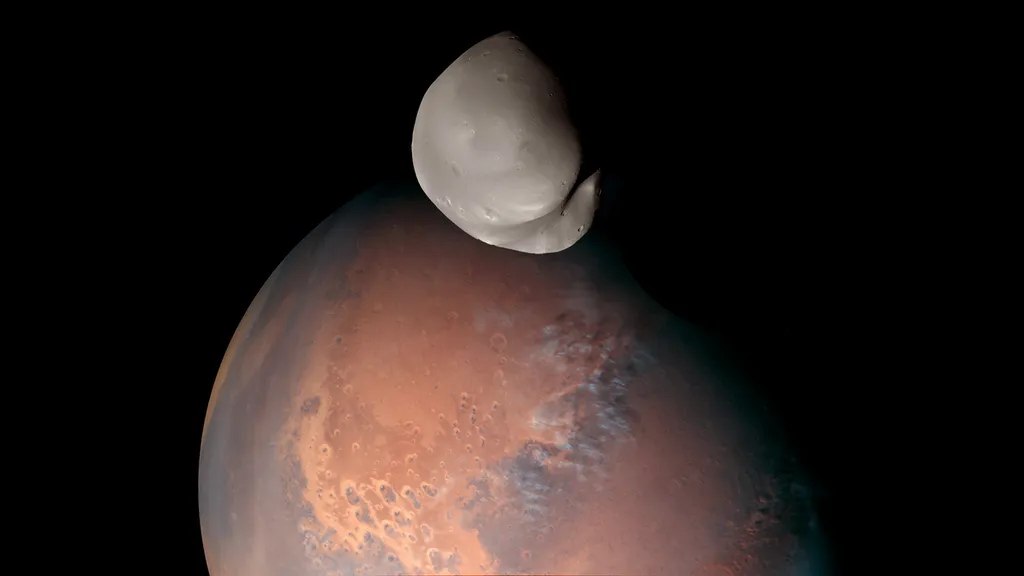
In the realm of planetary science, a trio of researchers from the University of Arizona—Kaustub P. Anand, Matija Ćuk, and David A. Minton—have been delving into the mysterious origins and evolution of Mars’ smaller moon, Deimos. Their work, published in the journal Astronomy & Astrophysics, offers a novel perspective on the moon’s past and present, with implications that could extend to other similar moons in our solar system.
The origins of Mars’ moons, Phobos and Deimos, have long been a topic of debate among scientists. Some theories suggest they formed from a disk of debris generated by a massive impact on Mars, while others propose they are captured asteroids. The researchers focused on the impact scenario, which posits that Deimos (or its precursors) was either formed or pushed out beyond Mars’ synchronous orbit—the distance at which an object’s orbital period matches the planet’s rotational period. Moons interior to this orbit, like Phobos, would tidally evolve, and resonances between these moons could potentially excite Deimos’ orbit. However, Deimos’ current orbit is characterized by low eccentricity and moderate inclination, which contradicts the idea of an excited orbit.
The researchers propose a phenomenon they term the “sesquinary catastrophe” to reconcile this contradiction. A sesquinary object is one that orbits a planet exterior to the synchronous orbit. In this case, Deimos is the sesquinary object. The catastrophe refers to a runaway collisional cascade that acts as a natural barrier, preventing Deimos from having a more excited orbit. Through N-body simulations with collisional fragmentation, the team showed that if Deimos was more excited, it would undergo this catastrophe and break apart into a debris disk. They found that breakup occurs when a measure of sesquinary orbital excitation, called q, is greater than approximately 8, on timescales of roughly 1,000 to 10,000 years.
If Deimos was destroyed in such a catastrophe and subsequently re-accreted from a damped debris disk, it should be a porous, sand-pile-like moon, consistent with its smooth surface. This research suggests that the sesquinary catastrophe could be applied to other Deimos-like planetary moons with a q value greater than 8. While this research is primarily of academic interest, understanding the formation and evolution of planetary moons can provide insights into the broader processes that shape our solar system. This knowledge could indirectly inform future missions to Mars and its moons, contributing to our broader understanding of the Martian system and its potential for exploration and resource utilization.
Source: Anand, K. P., Ćuk, M., & Minton, D. A. (2023). The sesquinary catastrophe on Deimos can reconcile its excited past with its dynamically cool present. Astronomy & Astrophysics.
This article is based on research available at arXiv.