
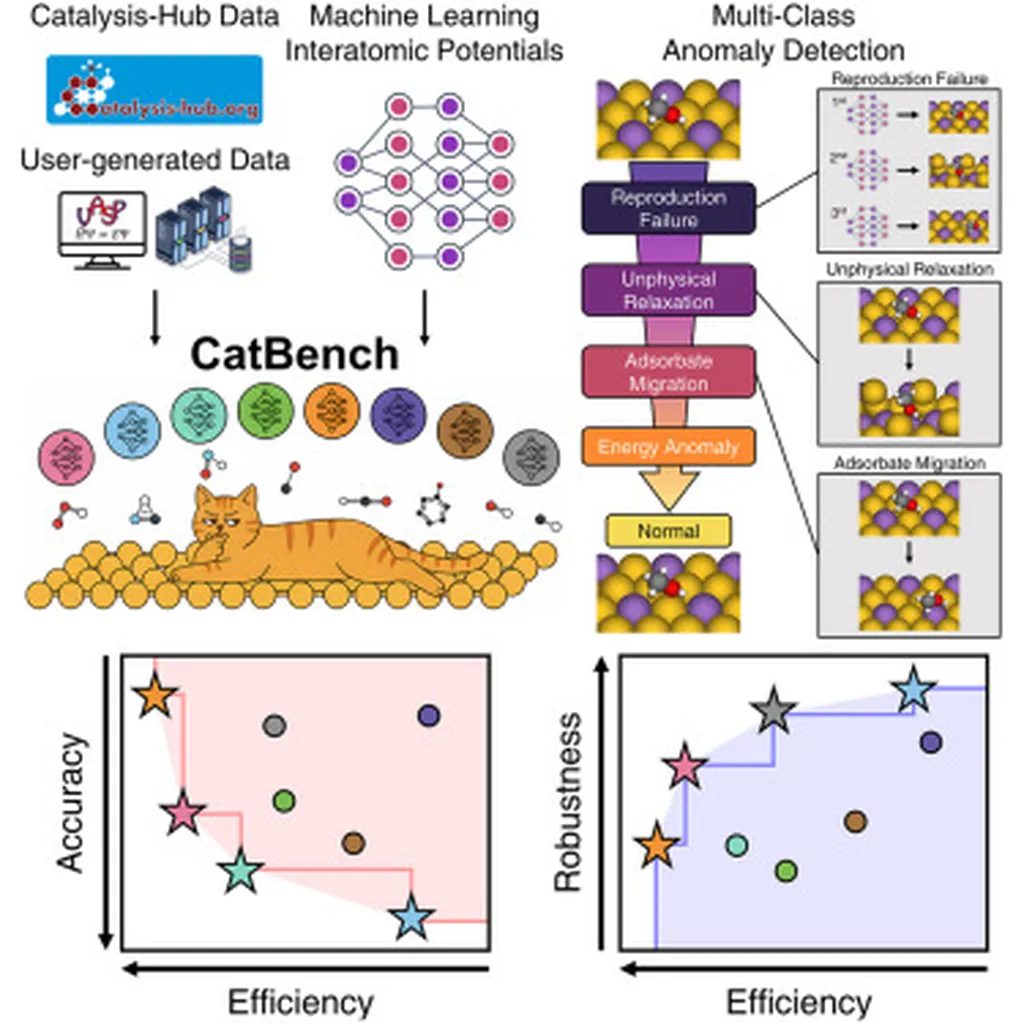
In the rapidly evolving field of energy research, machine learning is emerging as a powerful tool to enhance our understanding and prediction of complex systems. Researchers from the Technical University of Denmark, including Luuk H. E. Kempen, Raffaele Cheula, and Mie Andersen, have been at the forefront of this development, focusing on the application of machine learning interatomic potentials (MLIPs) in heterogeneous catalysis.
The team’s recent study, published in the journal Nature Communications, systematically evaluates the performance of 80 different MLIPs in tasks typical for heterogeneous catalysis. The research aims to bridge the gap between the rapid development of MLIPs and their practical application in the energy sector, particularly in areas like fuel cells, batteries, and catalytic converters.
The study finds that current-generation MLIPs can already perform at high accuracy for certain applications, such as predicting vacancy formation energies of perovskite oxides or zero-point energies of supported nanoclusters. These capabilities could significantly enhance the design and optimization of energy materials, leading to more efficient and cost-effective solutions.
However, the research also highlights some limitations. Many MLIPs catastrophically fail when applied to magnetic materials, a common component in many energy technologies. Additionally, the study notes that structure relaxation in the MLIP generally increases the energy prediction error compared to single-point evaluation of a previously optimized structure. This could impact the accuracy of predictions in dynamic systems, such as those found in operating energy devices.
The researchers also compare low-cost task-specific models to foundational MLIPs, highlighting core differences between these model approaches. They find that, in terms of accuracy, task-specific models can compete with the current generation of best-performing MLIPs. This suggests that for certain applications, simpler models may be sufficient, reducing computational costs and increasing accessibility.
Lastly, the study emphasizes that no single MLIP universally performs best. Users must investigate MLIP suitability for their desired application, underscoring the need for continued research and development in this field. As the energy sector increasingly turns to digital tools and data-driven approaches, the insights from this study will be invaluable in guiding the practical application of MLIPs in energy technologies.
In conclusion, while MLIPs hold great promise for the energy sector, their performance varies widely depending on the specific application. The findings from this study provide a crucial benchmark for researchers and industry professionals, helping to navigate the complex landscape of machine learning tools in energy research.
This article is based on research available at arXiv.