
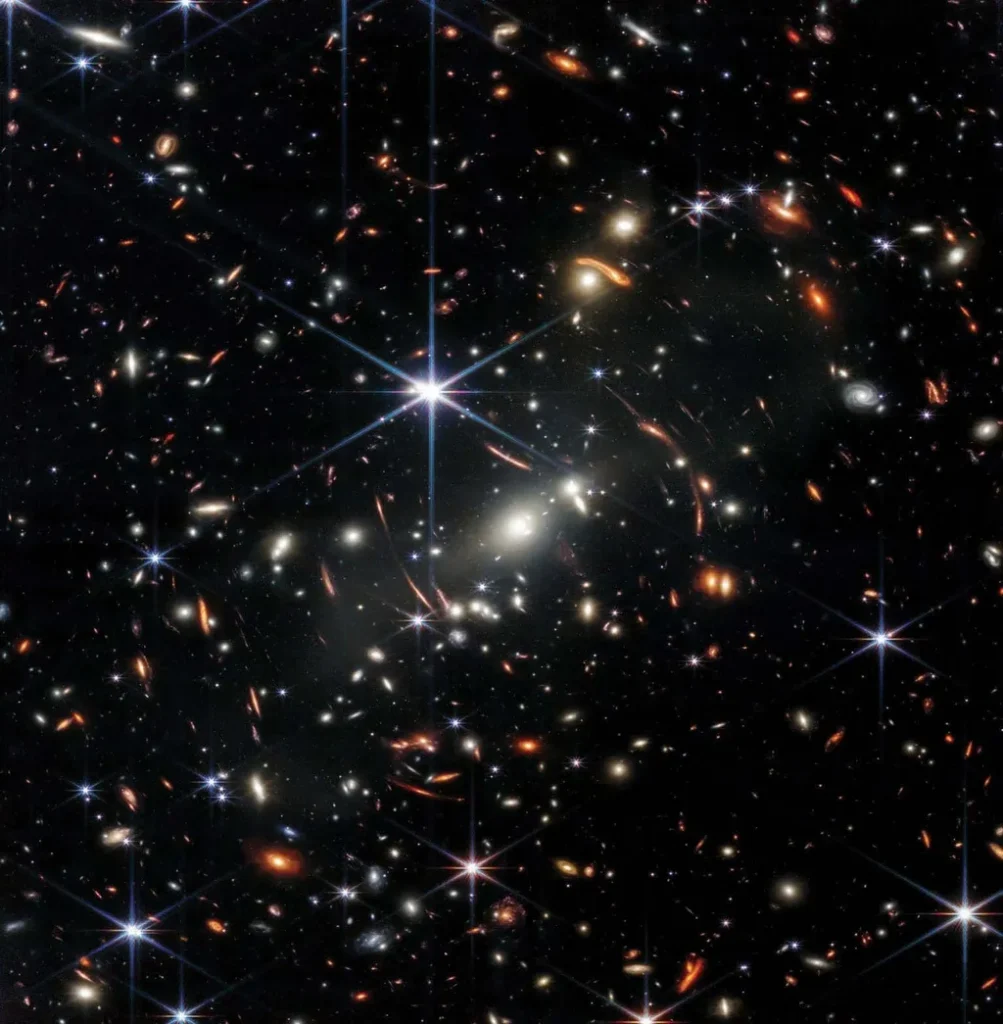
In a recent study, a team of researchers led by Ece Kilerci from the University of Tokyo and Tomotsugu Goto from the National Astronomical Observatory of Japan, along with collaborators from the University of California, Los Angeles, and other institutions, has developed a new method to classify galaxies using data from the James Webb Space Telescope (JWST). Their work focuses on understanding the properties of galaxies during a period known as cosmic noon, when star formation and galaxy growth were at their peak.
The researchers utilized the JWST’s Mid-Infrared Instrument (MIRI) to create a tool that can classify galaxies based on their mid-infrared (MIR) colors. By analyzing the largest Spitzer MIR spectral database, they were able to simulate photometry in the JWST/MIRI filters. This allowed them to identify key features such as polycyclic aromatic hydrocarbon (PAH) emissions and the 9.7-micron silicate feature across seven redshift windows ranging from z = 0.25 to 2.10.
The study presents color-color plots that effectively separate active galactic nuclei (AGN), star-forming galaxies (SFGs), and silicate absorption-dominated galaxies up to redshifts of approximately 2. The researchers applied this classification method to the Systematic Mid-infrared Instrument Legacy Extragalactic Survey (SMILES), the largest MIRI survey covering about 34 square arcminutes. This application helped identify AGN, SFGs, and silicate absorption-dominated galaxies out to substantial redshifts.
The JWST/MIRI SFGs sample includes galaxies with total infrared luminosities ranging from 10^9.2 to 10^11.9 solar luminosities at redshifts between 0.9 and 1.57. The majority of these galaxies are consistent with the main sequence of star-forming galaxies at redshift approximately 1. Additionally, the researchers identified the first examples of galaxies at redshift approximately 1 with deep silicate absorption.
This research, published in the Astrophysical Journal, provides a valuable tool for the energy sector, particularly in understanding the evolution of galaxies and the processes driving star formation. By identifying and classifying different types of galaxies, researchers can better study the conditions that lead to the formation of stars and the growth of galaxies, which in turn can inform our understanding of the universe’s energy dynamics. The practical applications for the energy sector include insights into the lifecycle of stars, which are crucial for modeling the energy output and evolution of galaxies over cosmic time.
This article is based on research available at arXiv.