
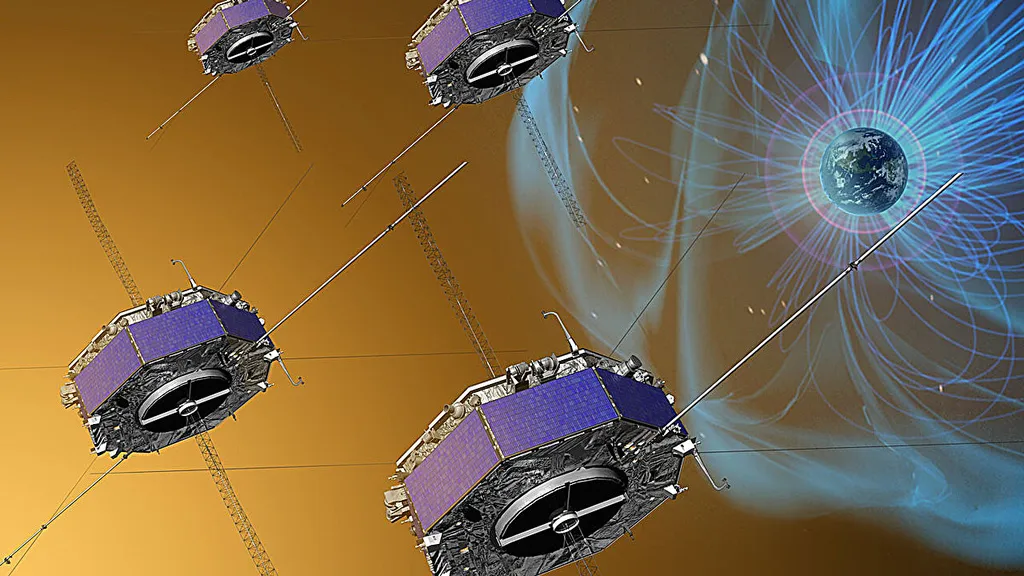
In the realm of energy research, a team of scientists from the University of Florence, Italy, has been delving into the complexities of magnetic reconnection in relativistic plasmas. The researchers, Vittoria Berta, Matteo Bugli, Andrea Mignone, Giancarlo Mattia, Luca Del Zanna, and Stefano Truzzi, have recently published their findings in the journal Physical Review Letters.
Magnetic reconnection is a fundamental process in plasma physics, where magnetic field lines break and reconnect, releasing energy. This process is crucial in understanding various astrophysical phenomena, including pulsar winds, gamma-ray flares, and pulsar nanoshots. The team’s research focuses on the dynamics of this process in three-dimensional (3D) space, using highly accurate numerical simulations.
The researchers explored how current sheets, which are regions of concentrated electric current, evolve and disrupt under the influence of the ideal tearing instability. This instability occurs when the current sheet reaches a critical inverse aspect ratio, which scales with the plasma Lundquist number. The team found that in 3D simulations, the onset, evolution, and efficiency of reconnection depend significantly on the local plasma conditions and the configuration of the current sheet.
In force-free configurations, where the plasma pressure is negligible, the 3D simulations revealed that ideal tearing, secondary instabilities, and a thick, turbulent current layer develop. This leads to a prolonged dissipation of magnetic energy compared to two-dimensional (2D) simulations. However, in pressure-balanced current sheets with a null guide field, the 3D simulations showed a different dynamics. Here, pressure-driven modes growing on forming plasmoids outcompete plasmoid coalescence, suppressing fast dissipation of magnetic energy after the linear phase.
These findings highlight the importance of considering the full 3D nature of magnetic reconnection in astrophysical plasmas. The results suggest that the efficiency of reconnection can be properly captured only in fully 3D simulations, providing a more accurate understanding of energy dissipation in various astrophysical environments. For the energy sector, this research could potentially inform the development of more efficient and stable plasma-based energy systems, such as fusion reactors, by offering insights into the complex dynamics of magnetic reconnection.
This article is based on research available at arXiv.