
In a recent study, a team of researchers led by Jin-Long Xu from the National Astronomical Observatories of China has shed new light on the mysterious process of how seemingly inactive galaxies can fuel their central black holes, known as active galactic nuclei (AGN). The team utilized the Five-hundred-meter Aperture Spherical radio Telescope (FAST) to observe the nearby elliptical galaxy NGC 4278 and its surrounding region.
The researchers discovered that NGC 4278, which was previously thought to be a “dead” galaxy with little ongoing star formation, is actually receiving a steady supply of gas from a neighboring galaxy. This process, known as gas accretion, is occurring due to tidal interactions between the two galaxies. The accreted gas forms a rotating disk within NGC 4278, providing fuel for its low-luminosity AGN. The neighboring galaxy, which is the source of the accreted gas, is found to be gas-poor, with a hydrogen to stellar mass ratio of about 0.02.
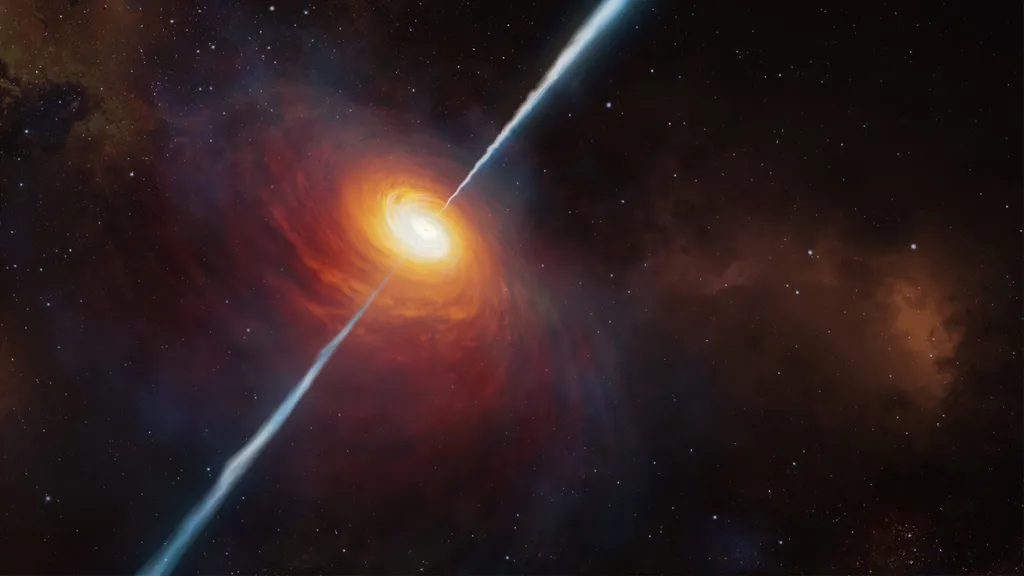
The study also suggests that the accretion of gas may be responsible for the generation of relativistic jets in the AGN of NGC 4278. These jets are powerful streams of particles that are ejected from the vicinity of the black hole at nearly the speed of light. Additionally, the researchers propose that the emission of TeV gamma rays, which are extremely high-energy photons, in NGC 4278 may be associated with the newly accreted hydrogen gas.
The findings of this study, published in the Astrophysical Journal, have important implications for our understanding of how galaxies evolve and interact with one another. In the context of the energy industry, the study highlights the potential for tidal interactions between galaxies to provide a source of fuel for AGN, which are among the most powerful energy sources in the universe. While the practical applications of this research may not be immediately apparent, a deeper understanding of the processes that govern the behavior of galaxies and their central black holes could have profound implications for our understanding of the universe and our place within it.
This article is based on research available at arXiv.