
Researchers from the University of Stuttgart, Germany, and the University of Tennessee, Knoxville, USA, have developed a new method to improve the accuracy of computer simulations used in the design of organic optoelectronic devices. The team, led by Dr. Arash Nikoubashman and Dr. Denis Andrienko, has introduced a strategy to better model the behavior of organic molecules in various environments, which could enhance the development of technologies like organic solar cells and light-emitting diodes. Their work was recently published in the journal Nature Communications.
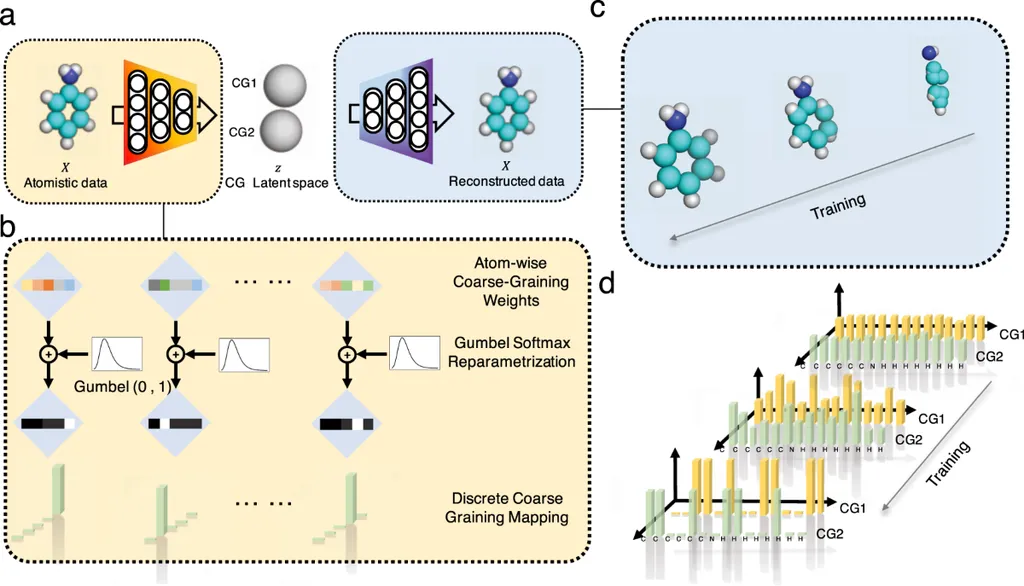
The researchers focused on a technique called coarse-graining, which simplifies the way molecules are represented in computer simulations. This simplification allows for faster simulations, but it often struggles to accurately model certain situations, such as the behavior of molecules at the surface of a thin film. The team addressed this issue by developing a new approach that adjusts the way molecules interact based on their local environment, leading to more accurate simulations.
In their study, the researchers tested their method on free-standing films made of organic molecules. They found that their new coarse-graining strategy could accurately reproduce the behavior of these molecules, both in the bulk of the material and at the surface. This improvement could help researchers better understand and design organic optoelectronic devices, as it allows for more reliable predictions of how molecules will behave in different parts of a device.
The practical applications of this research for the energy sector are significant. Organic solar cells, for instance, rely on the efficient transport of electrical charges, which is influenced by the arrangement of molecules at the interfaces within the device. By providing a more accurate way to model these interfaces, the new coarse-graining strategy could help in the design of more efficient organic solar cells. Similarly, in organic light-emitting diodes, the emission of light is influenced by the arrangement of molecules, and the new method could aid in the development of more effective lighting technologies.
In summary, the researchers have introduced a novel coarse-graining strategy that improves the accuracy of computer simulations for organic optoelectronic devices. This advancement could lead to more efficient and effective energy technologies, such as solar cells and light-emitting diodes. The research was published in Nature Communications.
This article is based on research available at arXiv.