
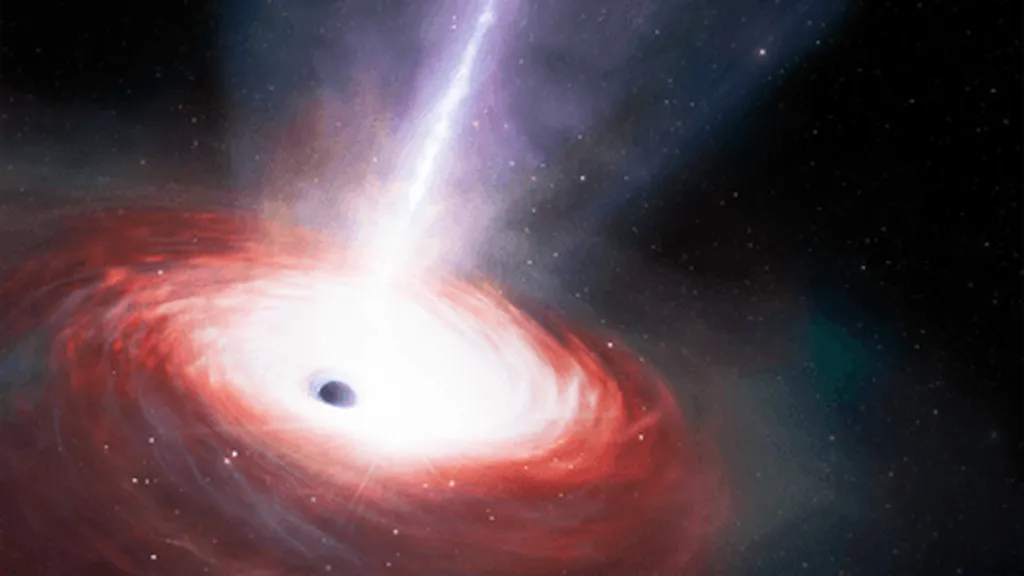
In the realm of astrophysics, a team of researchers led by Jialai Wang from the National Astronomical Observatories of the Chinese Academy of Sciences has made a significant discovery that could have implications for our understanding of black holes and, potentially, the energy sector. The team, which includes Mengqiu Huang, Yongquan Xue, and other esteemed scientists, has been studying tidal disruption events (TDEs), where stars are torn apart by black holes, to probe dormant black holes across a wide mass range.
The researchers presented their late-time observations and comprehensive multi-wavelength analyses of an extraordinary TDE at the center of a dwarf galaxy. This event exhibited successive flares in the optical, X-ray, and radio bands. Notably, they discovered an unexpected high-state X-ray plateau phase following the peak, which lasted until the present time. Additionally, the event showed a prolonged rise lasting at least 550 days. These unique characteristics led the team to conclude that the TDE was caused by an intermediate-mass black hole (IMBH) with a mass of approximately 100,000 to 600,000 times that of the sun. Scaling relations derived from the host-galaxy properties supported this finding.
The discovery underscores the invaluable role of TDEs in the search for elusive IMBHs. While this research is primarily astrophysical, it could have indirect implications for the energy sector. Understanding the behavior of black holes and their masses can contribute to our knowledge of the universe’s energy dynamics. For instance, studying the energy released during TDEs can provide insights into the energy potential of black holes and their role in galactic evolution. This knowledge could, in turn, inform theoretical models and simulations that explore the boundaries of energy production and consumption in the cosmos.
The research was published in the prestigious journal Nature Astronomy, where it contributes to the ongoing dialogue about black holes and their impact on the universe. As the energy sector continues to evolve, such astrophysical discoveries can inspire new ideas and approaches to energy generation and management.
This article is based on research available at arXiv.