
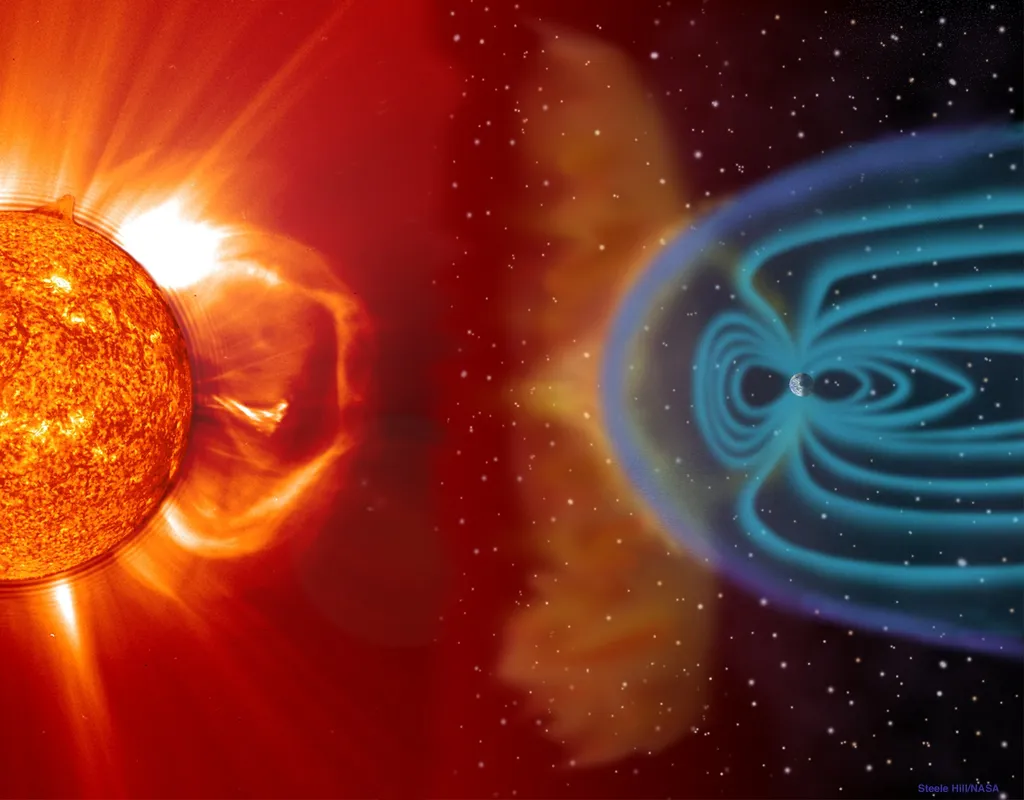
Researchers from the University of Science and Technology of China, the University of Delaware, and the University of Sydney have published a study in the journal Physical Review E, shedding light on the angular dependence of energy dissipation rates in magnetohydrodynamic (MHD) turbulence, particularly in the context of solar wind turbulence. This research could have practical implications for understanding and measuring turbulent energy dissipation in various plasma environments, including those relevant to the energy industry.
The study focuses on the estimation of energy transfer and dissipation rates in solar wind turbulence using third-order structure functions, which are calculated from spacecraft observations. The researchers note that solar wind turbulence is inherently anisotropic, meaning its properties vary depending on the direction of observation. This anisotropy can lead to significant variations in structure functions along different observational directions, affecting the accuracy of energy dissipation rate estimates.
To address this issue, the researchers conducted a series of MHD turbulence simulations with different mean magnetic field strengths. Their analysis revealed that the global energy dissipation rate estimated around a polar angle of 60 degrees agrees reasonably well with the exact rate for a range of magnetic field strengths. This special property of the 60-degree angle can be understood through the Mean Value Theorem of Integrals, as the spherical integral of the polar-angle component of the divergence of Yaglom flux is zero, and this component changes sign around 60 degrees.
The researchers also assessed existing theories on the energy flux vector as a function of the polar angle and found support for the speciality of the 60-degree angle. They further validated their findings using virtual spacecraft data analysis. The results of this study can be applied to improve the measurement of turbulent dissipation rates in the solar wind, which could have implications for other areas where turbulence occurs, such as laboratory plasmas and astrophysics.
In the context of the energy industry, a better understanding of turbulent energy dissipation in plasma environments could have practical applications in areas such as nuclear fusion research, where plasma turbulence can significantly impact the efficiency of fusion reactions. Additionally, improved methods for measuring energy dissipation rates could be valuable in the development of more accurate models for predicting space weather, which can affect satellite operations and power grid stability.
The research was published in the journal Physical Review E, and the study was conducted by Bin Jiang, Zhuoran Gao, Yan Yang, Francesco Pecora, Kai Gao, Cheng Li, Sean Oughton, William Matthaeus, and Minping Wan.
This article is based on research available at arXiv.