
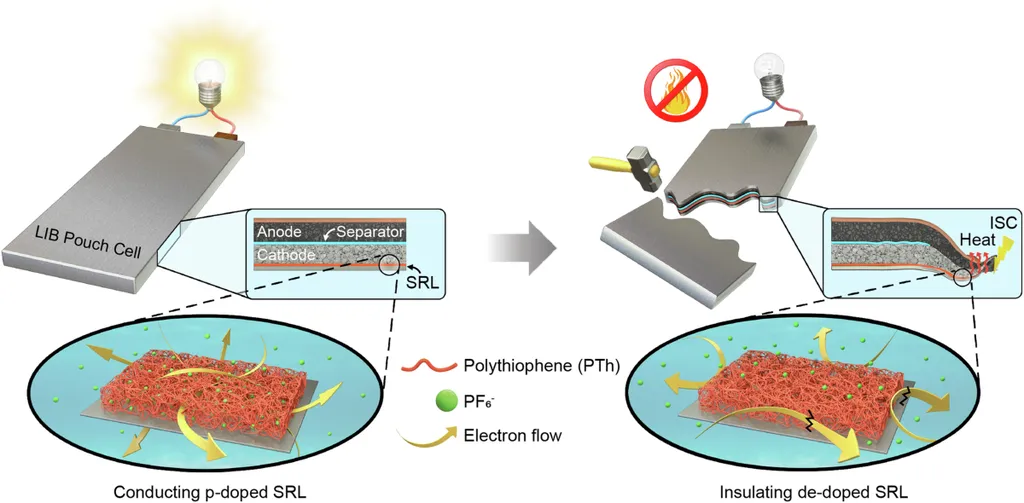
In the realm of energy storage, lithium-ion batteries are ubiquitous, powering everything from portable electronics to electric vehicles. However, their safety remains a concern, particularly due to the risk of thermal runaway, a condition where the battery overheats, potentially leading to fire or explosion. Researchers Benjamin C. Koenig and Sili Deng from the University of Michigan have been working on improving our understanding and prediction of this phenomenon.
In their recent study, Koenig and Deng tackle the challenge of predicting thermal runaway in lithium-ion batteries, focusing on the state of charge (SOC) dependence of thermal decomposition kinetics for Li-ion cathodes. Existing models often consider the SOC as a discrete variable, which limits their ability to capture the continuous SOC dependence that influences exothermic behavior during abuse conditions.
The researchers applied a novel approach using the Kolmogorov-Arnold Chemical Reaction Neural Network (KA-CRNN) framework. This method learns continuous and realistic SOC-dependent exothermic cathode-electrolyte interactions directly from differential scanning calorimetry (DSC) data. By embedding a mechanistically informed reaction pathway into the network architecture, the KA-CRNN can represent activation energies, pre-exponential factors, enthalpies, and related parameters as continuous and interpretable functions of the SOC.
The study demonstrated the effectiveness of this approach on three types of cathodes: NCA (Nickel Cobalt Aluminum), NM (Nickel Manganese), and NMA (Nickel Manganese Aluminum). The models developed were able to reproduce DSC heat-release features across all SOCs and provided interpretable insights into SOC-dependent oxygen-release and phase-transformation mechanisms.
The practical applications of this research for the energy sector are significant. More accurate and interpretable thermal-runaway prediction and monitoring can enhance the safety of lithium-ion batteries, which is crucial for their widespread use in electric vehicles and grid storage systems. Furthermore, the framework established by Koenig and Deng can be extended to include additional environmental and electrochemical variables, supporting even more precise predictions.
The research was published in the Journal of The Electrochemical Society, a leading publication in the field of electrochemical and solid-state science and technology. This work represents a step forward in understanding and mitigating the risks associated with lithium-ion batteries, contributing to the ongoing efforts to make energy storage safer and more reliable.
This article is based on research available at arXiv.