
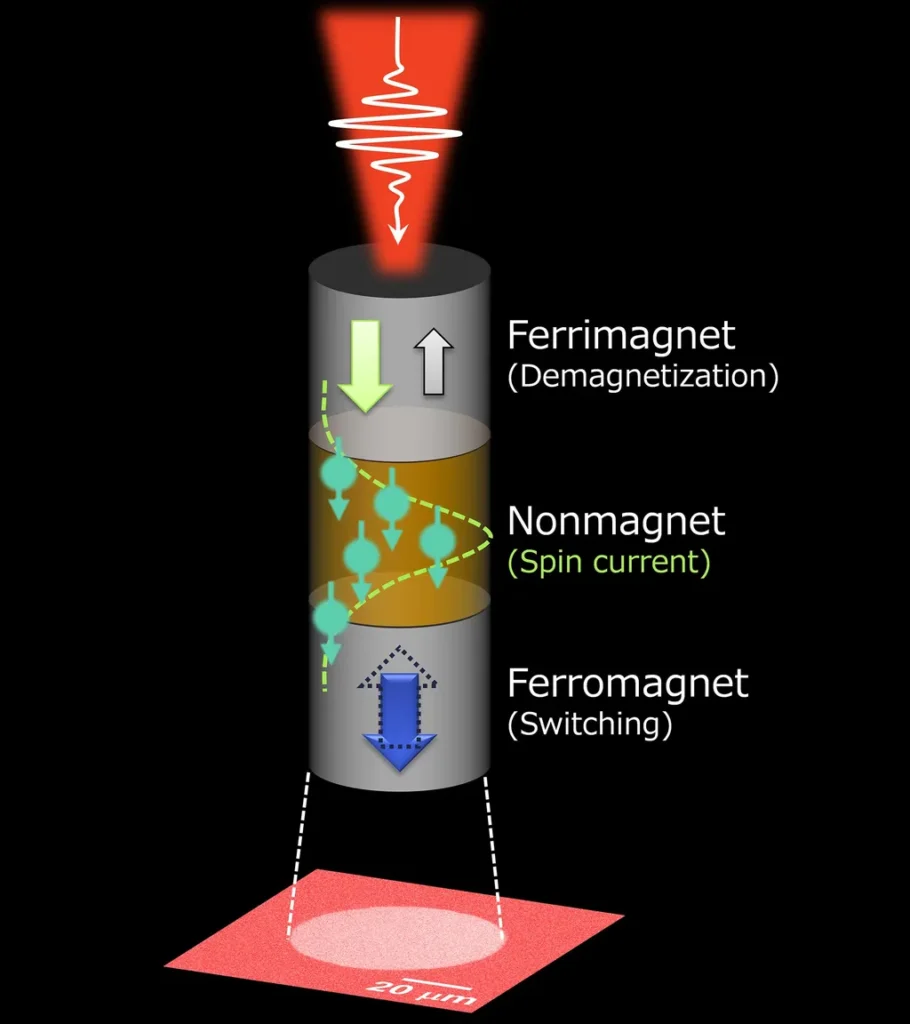
Researchers from the University of Leeds, including Serban Lepadatu, Mohammed Gija, Alexey Dobrynin, Kevin McNeill, Mark Gubbins, Tim Mercer, Steven M. McCann, and Philip Bissell, have recently published a study in the journal Physical Review B, exploring the mechanisms behind ultrafast all-optical switching in metallic spin valves. This research delves into the intricate dynamics of spin currents and charge distributions that occur on ultrafast timescales, providing valuable insights for the energy sector, particularly in the development of advanced magnetic storage and spintronic devices.
The study focuses on two primary sources of current transients that govern all-optical switching in ferromagnetic spin valves. The first source is spin currents pumped by the reference layer, while the second is spin-polarized currents resulting from non-equilibrium hot electrons excited by a laser pulse. The researchers found that an initial superdiffusive forward flow of electrons, polarized by the free layer, drives the switching from parallel to antiparallel states. This occurs due to the accumulation of minority spins at the reference layer. Following this initial flow, a diffusive backward flow of electrons, repolarized by the reference layer, takes place as the charge distribution re-equilibrates. The backward flow can drive antiparallel to parallel switching and create multi-domain structures at higher laser fluences and longer pulses.
The researchers’ findings are significant because they provide a comprehensive framework for self-consistent modeling of all-optical switching in metallic heterostructures. This understanding is crucial for the energy sector, particularly in the development of advanced magnetic storage technologies and spintronic devices. Spintronics, which leverages the spin degree of freedom in electrons, offers the potential for more energy-efficient and faster data processing and storage solutions. By optimizing the switching processes in spin valves, researchers can enhance the performance and reliability of these devices, contributing to more efficient energy use and reduced environmental impact.
In summary, the study by Lepadatu and colleagues offers a detailed look at the ultrafast dynamics of spin currents and charge distributions in metallic spin valves. Their findings provide a robust framework for modeling all-optical switching, which can be applied to develop more advanced and energy-efficient magnetic storage and spintronic devices. This research not only advances our fundamental understanding of spin dynamics but also paves the way for practical applications in the energy sector, particularly in the realm of spintronics and magnetic storage technologies.
Source: Lepadatu, S., Gija, M., Dobrynin, A., McNeill, K., Gubbins, M., Mercer, T., McCann, S. M., & Bissell, P. (2023). Laser-Induced Current Transients in Ultrafast All-Optical Switching of Metallic Spin Valves. Physical Review B, 107(10), 104410.
This article is based on research available at arXiv.