
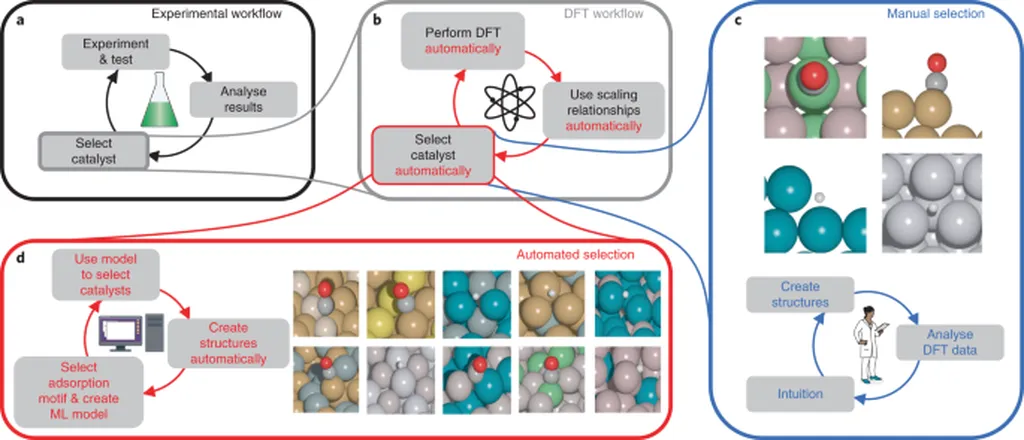
In the realm of energy research, catalysts play a pivotal role in facilitating chemical reactions, making them indispensable in various energy technologies, from fuel cells to electrolyzers. Researchers Songze Huo and Xiao-Ming Cao, affiliated with the University of Science and Technology of China, have developed a novel approach to accelerate the screening of catalysts, potentially revolutionizing the energy sector.
The researchers have introduced DBCata, a deep generative model designed to enhance the accuracy and efficiency of catalyst screening. Traditional methods often rely on machine learning interatomic potentials (MLIPs) trained on near-equilibrium structures, which can lead to unreliable adsorption structures and energy predictions. DBCata addresses this limitation by integrating a periodic Brownian-bridge framework with an equivariant graph neural network. This combination establishes a low-dimensional transition manifold between unrelaxed and Density Functional Theory (DFT)-relaxed structures, eliminating the need for explicit energy or force information.
One of the standout features of DBCata is its ability to generate high-fidelity adsorption geometries. According to the researchers, DBCata achieves an interatomic distance mean absolute error (DMAE) of 0.035 Å on the Catalysis-Hub dataset, a performance nearly three times better than current state-of-the-art MLIP models. This enhanced accuracy is crucial for reliable catalyst design and optimization.
To further improve the accuracy, the researchers employed a hybrid chemical-heuristic and self-supervised outlier detection approach. This method identifies and refines anomalous predictions, achieving DFT accuracy within 0.1 eV in 94% of instances. The practical implications of this research are significant, particularly in the context of high-throughput computational screening for efficient alloy catalysts in the oxygen reduction reaction (ORR). The ORR is a critical process in fuel cells, which are key components in various energy technologies, including hydrogen fuel cells for transportation and stationary power applications.
The researchers demonstrated that DBCata’s remarkable performance facilitates accelerated screening processes, making it a powerful tool for catalyst design and optimization. This advancement could lead to more efficient and cost-effective catalysts, ultimately contributing to the development of cleaner and more sustainable energy technologies. The research was published in the journal Nature Communications, a reputable source for high-quality scientific research.
In summary, the development of DBCata represents a significant step forward in the field of catalyst screening. By enhancing the accuracy and efficiency of this process, the energy sector can benefit from more effective catalysts, driving innovation and progress in various energy technologies. This research underscores the potential of advanced computational methods in addressing real-world energy challenges.
This article is based on research available at arXiv.