
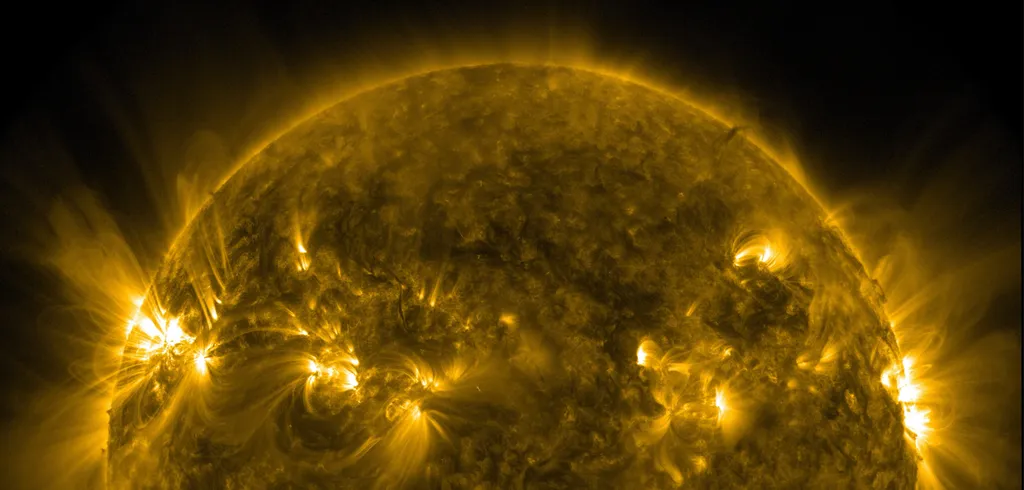
In a recent study, a team of researchers from the Astrophysics Research Centre at Queen’s University Belfast, led by Luke Majury, has shed new light on the role of erupted material in solar flare irradiance enhancements. The team, which includes Marie Dominique, Ryan Milligan, Dana-Camelia Talpeanu, Ingolf Dammasch, and David Berghmans, has been investigating the dynamics of solar flares and their impact on ultraviolet (UV) irradiance.
Solar flares are sudden, intense bursts of radiation from the Sun, often accompanied by the eruption of material. While the energy released during these events has been extensively studied, the contribution of the erupted material to the overall irradiance has been largely overlooked. The team analyzed nine significant solar flares, known as M- and X-class flares, which occurred between 2024 and early 2025. They used data from the Solar Dynamics Observatory’s Atmospheric Imaging Assembly (SDO/AIA) to separate the irradiance contributions from the flare ribbons and the erupted material.
The researchers found that the erupted material can significantly contribute to the UV irradiance enhancements during solar flares. On average, the erupted material accounted for 10% to 24% of the excess radiated energy, depending on the specific UV wavelength observed. This finding challenges the traditional view that flare ribbons are the primary source of irradiance enhancements. The study also revealed that nonthermal heating within the eruptions was minimal, suggesting that other mechanisms such as Ohmic heating or the dissipation of magnetohydrodynamic (MHD) waves might be responsible for the observed heating.
The practical implications of this research for the energy sector, particularly solar energy, are significant. Understanding the dynamics of solar flares and their impact on UV irradiance can help improve the forecasting of space weather events, which can disrupt satellite communications and power grids. Moreover, a better understanding of the energy distribution during solar flares can aid in the development of more efficient solar power systems that harness the Sun’s energy.
The research was published in the Astrophysical Journal, a peer-reviewed scientific journal that covers all aspects of astronomical research. The study’s findings contribute to our understanding of solar flares and their impact on the Sun’s UV output, which is crucial for various applications in the energy sector.
This article is based on research available at arXiv.