
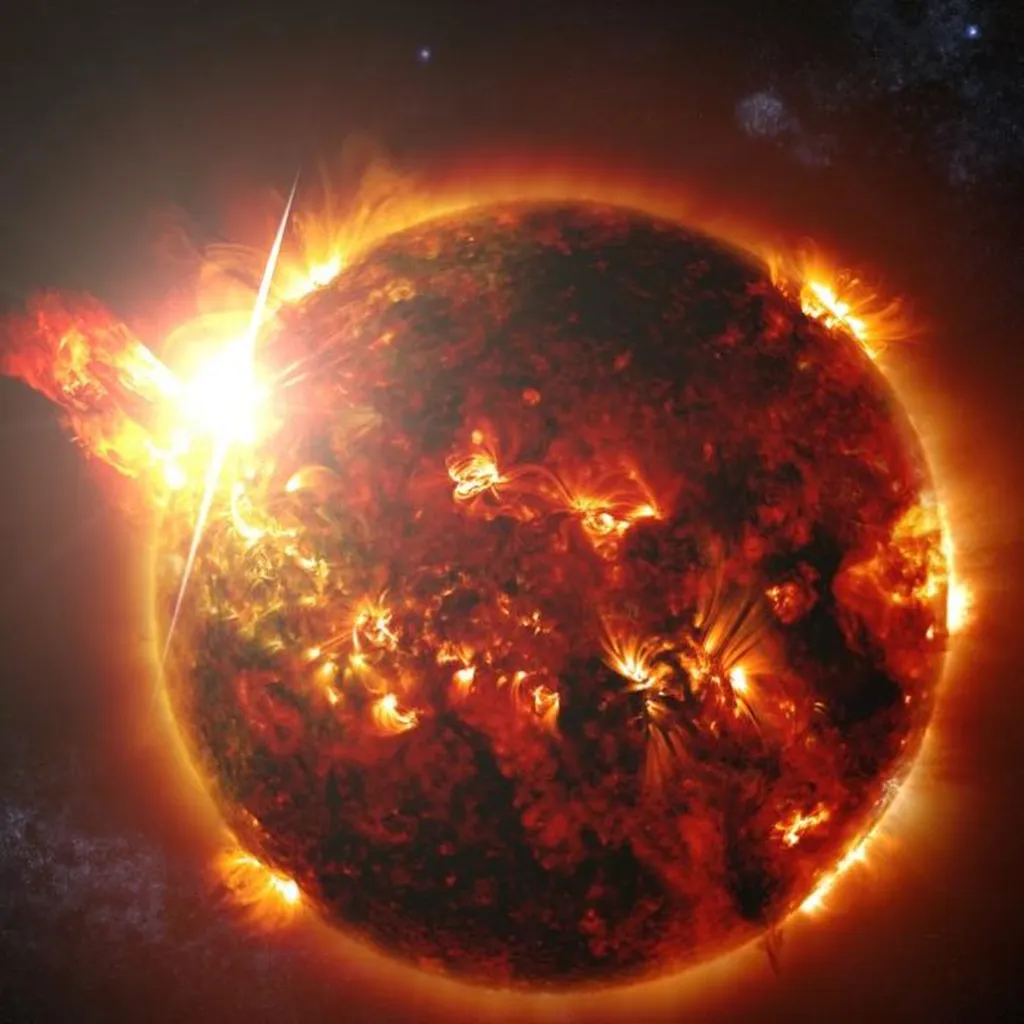
Researchers Yu Shi, Hong-Peng Lu, Li-Yun Zhang, Tian-Hao Su, and Chao Tan, affiliated with the University of Science and Technology of China, have published a study in the Astrophysical Journal that employs machine learning to identify stellar flares potentially associated with coronal mass ejections (CMEs) in data from the Transiting Exoplanet Survey Satellite (TESS). Their work aims to better understand the relationship between flares and CMEs, which has significant implications for assessing the impact of stellar activity on exoplanetary atmospheres and their potential habitability.
The researchers compiled a sample of 1,766 solar flares, specifically M-class and larger, using data from the Geostationary Operational Environmental Satellites (GOES) X-Ray Sensor (XRS) 1–8 Å channel. They extracted features from these flares using both deep convolutional neural networks and manual methods. Five machine-learning classifiers were then trained to distinguish between eruptive flares, which are associated with CMEs, and confined flares, which are not. The random forest model performed best, achieving a true skill statistic (TSS) of 0.31, indicating moderate ability to discriminate between the two types of flares.
The study found that normalized white-light and GOES XRS flare light curves show broadly consistent temporal evolution, reflecting their shared energy-release history. This consistency supports the probabilistic transfer of the model to white-light flare data. The researchers applied the best-performing random forest model to 41,405 TESS-detected flares on FGKM-type main-sequence stars. The model predicted that approximately 47% of these events show CME-like morphological characteristics, with the intrinsic association fraction likely ranging from 35% to 60%.
Interestingly, the study found that the CME occurrence rate decreases with increasing flare energy. This suggests that the most energetic flares may be more strongly confined by overlying magnetic fields. These findings provide new insights into the connection between flares and CMEs in diverse stellar environments and have important implications for understanding the impact of stellar eruptive activity on exoplanetary atmospheres.
For the energy sector, this research could indirectly influence the development of space weather forecasting technologies. Accurate prediction of solar and stellar flares and CMEs is crucial for protecting satellites, power grids, and other critical infrastructure from the potentially devastating effects of space weather events. By improving our understanding of the relationship between flares and CMEs, this study contributes to the broader effort to enhance space weather prediction capabilities.
Source: Shi, Y., Lu, H.-P., Zhang, L.-Y., Su, T.-H., & Tan, C. (2023). A Machine-Learning Approach for Identifying CME-Associated Stellar Flares in TESS Observations. The Astrophysical Journal, 944(2), 168.
This article is based on research available at arXiv.