
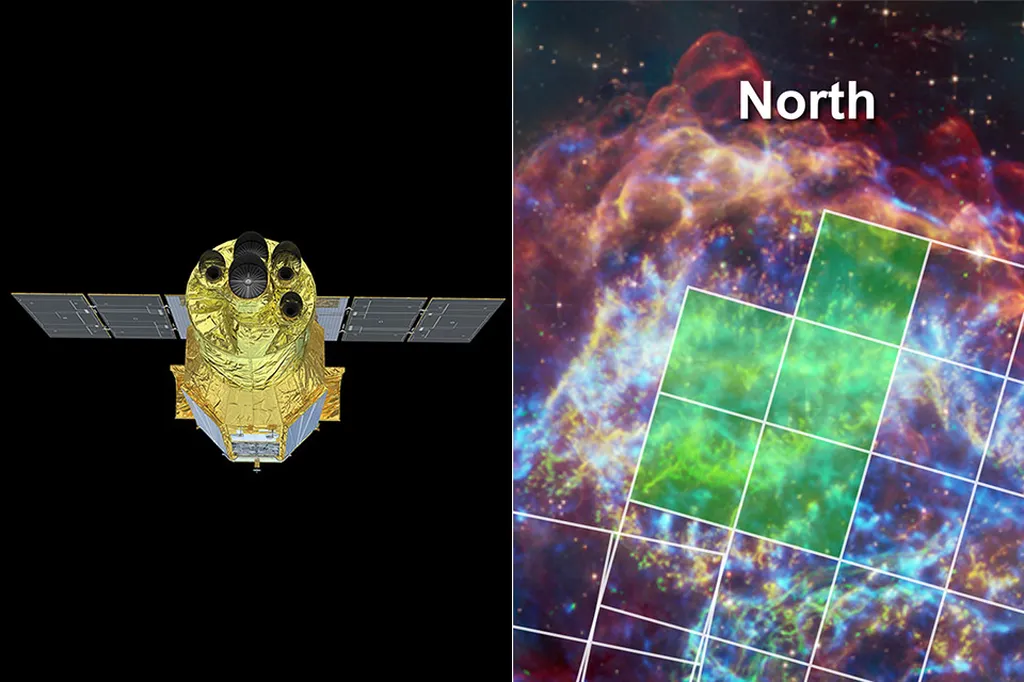
In a recent study led by Miki Kurihara from the Japan Aerospace Exploration Agency (JAXA), an international team of researchers has made significant strides in understanding stellar flares through high-resolution X-ray spectroscopy. The team, including scientists from various institutions such as the University of Maryland, MIT, and NASA, utilized the Resolve instrument onboard the XRISM satellite to observe the RS CVn-type binary star HR 1099.
The researchers observed a stellar flare lasting approximately 100,000 seconds, releasing an enormous amount of X-ray radiation energy. This observation is notable as it marks the first time a stellar flare has been observed using an X-ray microcalorimeter spectrometer. The flare’s peak count rate was 6.4 times higher than during the quiescent phase, providing a clear distinction in the time domain due to the extended telescope time.
The study detected numerous emission lines in the 1.7–10 keV range during both the flare and quiescent phases. By leveraging the high spectral resolution of the Resolve instrument in the Fe K band (6.5–7.0 keV), the team was able to resolve the inner-shell lines of Fe XIX–XXIV as well as the outer-shell lines of Fe XXV–XXVI. These lines have peaks in their contribution functions at different temperatures over a wide range, allowing the researchers to construct the differential emission measure (DEM) distribution over the electron temperature of 1–10 keV (roughly 10–100 million Kelvin) based solely on Fe lines, without assuming elemental abundance.
The reconstructed DEM exhibited a bimodal distribution, with only the hotter component increasing during the flare. The researchers also derived the elemental abundance based on the DEM distribution. Notably, they observed a significant increase in the abundance of calcium and iron during the flare, which are elements with some of the lowest first ionization potentials among those analyzed. However, this increase was not observed for silicon, sulfur, and argon. This behavior has been seen in some giant solar flares, and the present result provides a clear example in stellar flares.
The practical applications of this research for the energy sector are primarily in the realm of understanding and predicting stellar activity, which can impact space weather and, consequently, satellite operations and power grids on Earth. By improving our understanding of stellar flares, we can better prepare for and mitigate the potential impacts of space weather events on energy infrastructure.
This research was published in the journal Nature Astronomy.
This article is based on research available at arXiv.