
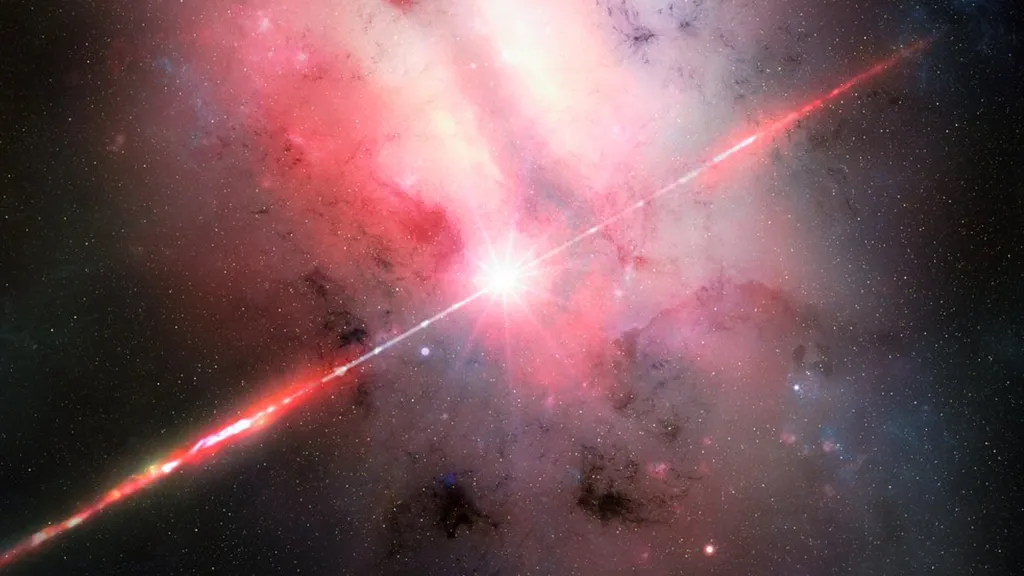
In the realm of astrophysics and energy research, a team of scientists led by Jonathan Granot from the Open University of Israel has been delving into the mysteries of a peculiar cosmic event. The team includes Hagai B. Perets, Ramandeep Gill, Paz Beniamini, and Brendan O’Connor, all of whom have contributed to unraveling the enigma of GRB 250702B, the longest gamma-ray burst (GRB) ever recorded.
Gamma-ray bursts are intense flashes of gamma rays that last from a few milliseconds to several hours, and they are among the most energetic events in the universe. GRB 250702B, with its multiple gamma-ray emission episodes spread over more than 25,000 seconds, has puzzled researchers. The burst is offset from its host galaxy center by about 5.7 kiloparsecs and displays a long-lived afterglow emission across the radio to X-ray spectrum. Two leading theories have emerged to explain this phenomenon: an ultra-long GRB or a tidal disruption event (TDE) caused by an intermediate-mass black hole (IMBH).
The researchers have focused on the latter scenario, proposing a model where a main-sequence star is disrupted by an IMBH. They have modeled the afterglow data, revealing a stratified external density profile consistent with Bondi accretion of the interstellar medium. This model allows them to infer the IMBH mass, which they estimate to be around 6,550 solar masses, with some variability based on the initial number density and sound speed of the interstellar medium.
The team’s findings, published in the journal Nature Astronomy, suggest that the gradual rise to the peak of the burst could be attributed to the gradual circularization and accretion disk buildup, leading to an increase in the jet’s power and Lorentz factor. This research provides valuable insights into the nature of GRBs and the behavior of intermediate-mass black holes, which could have implications for understanding the energy dynamics in the universe.
While the direct practical applications for the energy sector might not be immediately apparent, the study of such extreme cosmic events can indirectly contribute to our understanding of fundamental physics and energy processes. For instance, the mechanisms behind accretion disks and jet formation in black holes can offer insights into plasma physics and magnetic field dynamics, which are relevant to fusion energy research. Additionally, the extreme conditions around black holes can help us understand the limits of energy conversion and transfer, pushing the boundaries of our knowledge in energy science.
This article is based on research available at arXiv.