
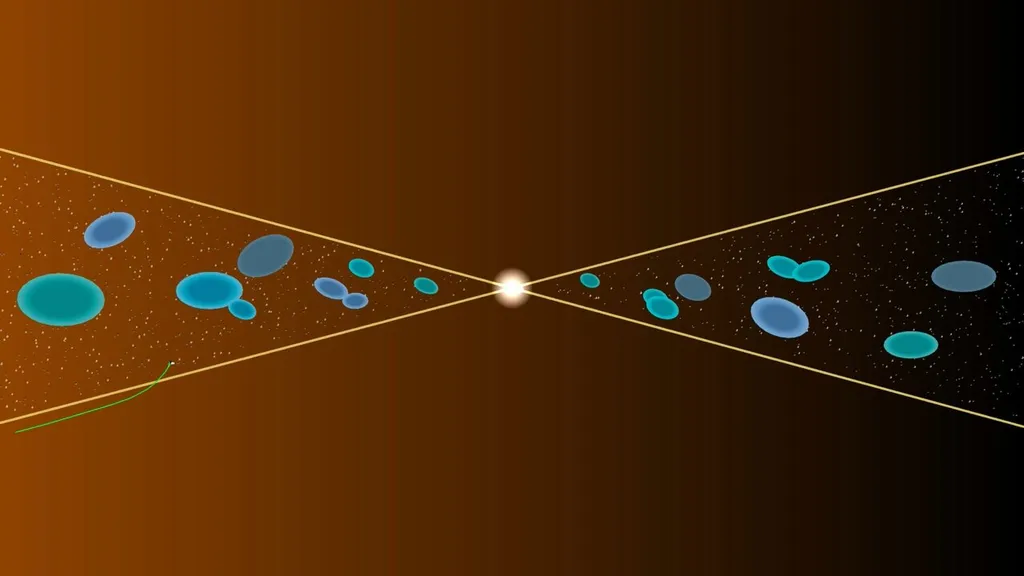
In the realm of solar physics, a trio of researchers from the Chinese Academy of Sciences, Jun Zhang, Tao Ding, and Yulei Wang, have been delving into the mysteries of magnetic reconnection in the solar atmosphere. Their recent study, published in the Astrophysical Journal, sheds light on the intriguing phenomenon of solar atmospheric structures vanishing during magnetic reconnection events.
Magnetic reconnection is a process that alters the topological connectivity of magnetic fields in the solar atmosphere, releasing magnetic energy. While this process is well-documented, the changes in the length of the reconnecting structures have not been extensively studied. To address this gap, the researchers set out to identify and analyze reconnection events that met three specific criteria. These included the presence of an explicit X-type configuration consisting of two sets of independent atmospheric structures, a clearly observable reconnection process, and the ability to track the topological connectivity of the structures from at least five minutes before to five minutes after the reconnection.
The team selected three events that met these criteria and found that during the reconnection moment, the total length of the two topological structures in each event shortened suddenly. The decrements were 47 Mm, 3.7 Mm, and 8.2 Mm for events 1, 2, and 3, respectively. This observation implies that partial structures vanish during the magnetic reconnection process.
The researchers discussed several possibilities to explain this vanishment. These include the shrinkage of the reconnecting structures due to magnetic tension, a bizarre change in the third dimension, and magnetic field annihilation. The study provides valuable insights into the dynamics of magnetic reconnection in the solar atmosphere, which can have implications for understanding solar flares and coronal mass ejections that impact space weather and, by extension, energy infrastructure on Earth.
Understanding these processes is crucial for predicting and mitigating the effects of solar activity on space weather, which can disrupt satellite operations, power grids, and communication systems. This research contributes to the broader effort to improve space weather forecasting and protect critical energy infrastructure.
The research was published in the Astrophysical Journal, a peer-reviewed scientific journal that covers all aspects of astronomical research.
This article is based on research available at arXiv.