
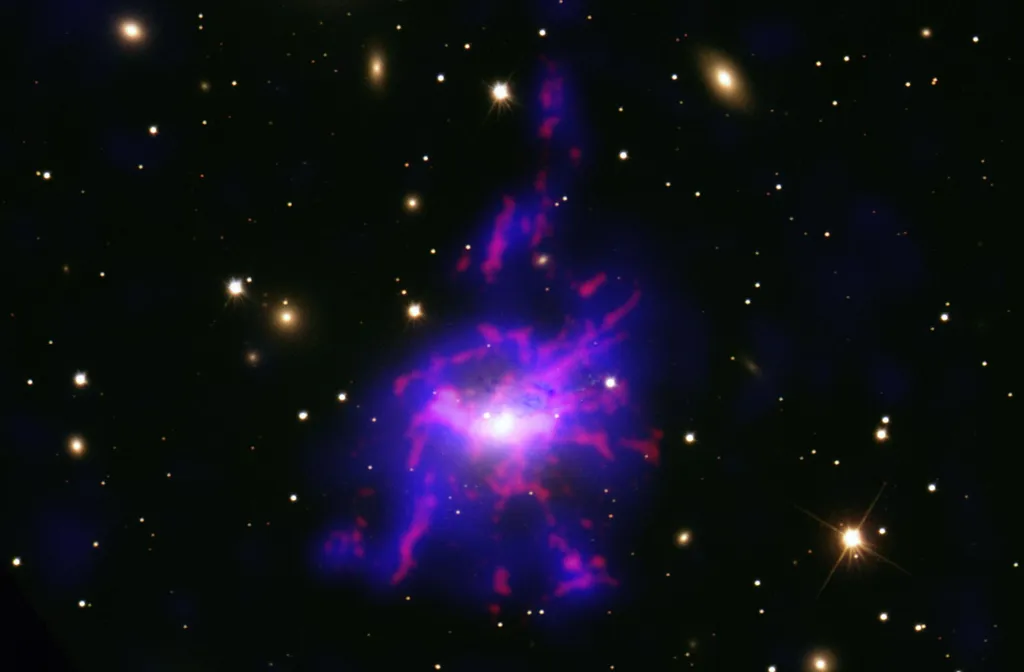
In the realm of astrophysics and energy research, a team of scientists from Columbia University, including Semih Tuna, Brian D. Metzger, Yan-Fei Jiang, and Andrea Antoni, have been delving into the intriguing phenomena that occur when a star ventures too close to a black hole. Their work, published in the Monthly Notices of the Royal Astronomical Society, explores the cooling process of stellar debris following a tidal disruption event (TDE), where a black hole’s tidal forces tear apart a star. Understanding these processes can provide insights into energy transfer and accretion disk formation, which have implications for various astrophysical and energy-related phenomena.
When a star is disrupted by a black hole, the resulting stellar debris forms a hot, diffuse envelope around the black hole. This envelope must cool efficiently to allow the debris to settle into a compact accretion disk, a process that is not yet fully understood. The researchers initiated axisymmetric radiation-hydrodynamic simulations to investigate this cooling process. They created models of TDE envelopes, taking into account the total mass, angular momentum, and binding energy expected from a complete stellar disruption.
In their simulations, the envelopes were supported by radiation pressure on large scales and rotation near the circularization radius, where the debris begins to form a disk. The researchers found that the envelopes evolved through a combination of radiative diffusion, turbulent mixing, and polar outflows. In their fiducial model, a quasi-steady state was achieved, characterized by a polar outflow that radiated and expelled matter at several times the Eddington luminosity—the maximum luminosity that can be radiated away without disrupting the inflow. This process enabled the envelope to cool and contract, forming a dense, rotationally supported ring near the circularization radius. Notably, this contraction occurred roughly ten times faster than the expected photon-diffusion timescale.
Comparative models without radiation transport confirmed that cooling, rather than purely adiabatic evolution, was essential for driving this rapid inflow. However, the researchers found that the effective envelope cooling time scaled only weakly with its optical depth, implying that advective and wind-driven energy transport dominated over diffusion. This means that the energy was primarily carried away by the outflowing material rather than being radiated away locally.
The findings demonstrate that cooling-induced contraction, even without viscosity and associated black hole accretion, can produce luminosities and large photosphere radii consistent with early UV/optical TDE emission. This suggests that the cooling process plays a crucial role in the early evolution of TDEs and the formation of accretion disks. However, the researchers note that more quantitative light-curve predictions must incorporate the self-consistent formation and feeding of the envelope by fallback accretion, where additional stellar debris falls back onto the black hole over time.
For the energy sector, understanding these astrophysical processes can provide insights into energy transfer mechanisms, accretion disk dynamics, and the behavior of matter under extreme conditions. These insights can inform the development of energy technologies and strategies, particularly in areas involving plasma physics, magnetic confinement, and high-energy density physics. By studying the cooling and contraction of TDE envelopes, researchers can gain a deeper understanding of how energy is dissipated and transferred in various astrophysical and laboratory settings, ultimately contributing to advancements in energy research and technology.
The research was published in the Monthly Notices of the Royal Astronomical Society.
This article is based on research available at arXiv.